POS-MOBILE

Advantages of Mobile POS

A mobile POS system consists of POS applications that can be installed on Windows or iPad devices, allowing workers to communicate with customers wherever they are in your shop.

In a recent survey, 52.8 percent of shoppers said they’re searching for tablet-carrying retail staff; meaning they want the best technology for their squad.

So, what market advantages can these mobile point selling systems bring to your company?

Minimise walkouts and showrooming

As soon as your customer walks into your store, they are looking to confirm that the product meeting their requirement is readily available in stock, know the cost of the product, and answer some relevant questions to help them decide whether they want to purchase.

Shoppers frequently feel reluctant to reach the counter to ask a question. Most will simply go out (often engaging in showrooming) if you don’t quickly present to them this key decision-making information as they browse your store.

You can intercept the process with a Mobile POS solution and proactively engage the customer, armed with all the information in your POS system to make the sale easier.

The integrated mobile point-of-sale program empowers the employees to quickly find specific items and to provide real-time inventory availability, pricing, and a host of other product information. It will use Google-like fuzzy matching so that workers are assured that their searches will return specific products or provide the closest match to offer a selection of alternatives, increasing the likelihood of winning the deal.

When providing a great shopping experience, the ability to quickly pull up product information and pricing specifics when engaging with the consumer is crucial.

It also allows the employees to close the sale with enticing deals that will not weaken the bottom line.

Where there is no inventory of appropriate items in store, the workers can see what is available in other locations in real-time and arrange automatic stock transfers for home delivery and pick-up from other outlets.

You can even integrate in-store display browsing with all the stock in your store network so that the customer can search and make quick purchases.

To know more about how to engage customers click here.

Cross-sell and Upsell to maximize the basket size:

An innovative Mobile Point Sale platform allows the employees to engage consumers in the shop they are interested in, and then quickly identify and offer them a selection of up-selling and cross-selling items to increase basket size. Staff can easily identify what items to choose for up-sell / cross-sell that are specific to each situation/customer. This takes into account the old stock, the items labeled, and the inventory available at other locations or outlets.

Drive named sales and reward loyal customers

Capturing customer information is easy and reliable to see your phone screen and correct any possible errors on your mobile POS display.

You can encourage the customer to provide these details using built-in loyalty programs. Your staff can then pull up demographic information for occasional shopping / cross-selling on their mobile POS such as age and gender when they visit. For example, they could cross-sell for men and children when they know that a customer has a husband and children. If the customer has a buying history, the sales team can take advantage of previous purchases to suggest items related to past sales.

Selling via pop-up stores

A mobile POS device is your ideal solution when you sell at trade shows, car park sales, markets, or pop-up shops. With the Mobile POS app, stock levels between all your stores, including your eCommerce website, are changed in real-time, giving you a clear idea of what to sell at any time.

Lower shrinkage in-store

Because your sales team has more time to engage in-store buyers, shoplifting, operational mistakes, and retailer fraud may decrease common shrinkage. With less time behind the counter, staff may concentrate on other sales tactics to boost profits.

PCI-DSS

What is PCI DSS Compliance?

The Payment Card Industry Data Security Standard (PCI DSS) is a set of security standards designed to maintain a secure environment for all entities that accept, process, store, or transfer credit card information. The PCI DSS is operated by the PCI SSC, an independent body produced by major brands of payment cards (Visa, MasterCard, American Express, Discover, and JCB)

Compliance with PCI is required to secure and protect online transactions from identity theft. According to the PCI Compliance Security Standard Committee, any merchant that wishes to process, store or transfer credit card data is required to comply with PCI. The PCI DSS refers to any entity that receives, transmits, or retains any cardholder data, regardless of the size or number of transactions.

In short, PCI DSS is a set of regulations created by major brands of payment cards including Visa, MasterCard, American Express, Discover, and JCB. This scheme allows organizations to meet general data security requirements that must be met by each merchant.


The following are the security requirements:

Build and Maintain a Secure Network:

To protect cardholder data, install and maintain a firewall configuration. Do not use defaults provided by the vendor for system passwords and other security parameters.

Protection of Card-Holder data:

Protect stored cardholder data. Encrypt cardholder data transmission through open public networks

Maintain a Vulnerability Management Program:

Use or upgrade anti-virus software or system regularly Develop and maintain secure systems and applications

Implement Strong Access Control Measures:

Restrict access to cardholder information by businesses and know how to allocate a unique ID to each person with computer access.

Regularly Monitor and Test Networks:

Track all connections to network resources and cardholder information regularly.

Maintain an Information Security Policy:

Maintain a framework for the protection of information for all workers

Risks that your organization runs by not having PCI DSS compliance:

Businesses that don’t accept any credit cards sometimes question why they need to follow a safety requirement such as the PCI DSS. In the Payment Card Industry (PCI) world, companies that do not process more than 20,000 credit card transactions per year are categorized as level 4 merchants. This level 4 has the lowest level of compliance requirements and therefore requires the lowest level of compliance effort. However, this tier of merchants is also the most vulnerable to crime and cyber-attacks, according to data from the Payment Card Industry. Seventy-one percent of hackers target small businesses and retailers with less than 100 employees, according to the PCI Security Standards Council (PCI, 2016). In addition to the threat of a data breach, agreements with an acquirer or payment processor can require that your company comply with PCI. This is valid for any company that even accepts a single payment credit card.

Benefits of PCI DSS: 

Security improvement:

A study conducted by Verizon found that companies that comply with PCI are more likely to resist substantially up to fifty percent of a cardholder data breach. This means that the 12-required PCI DSS is an effective collection of security checks to protect cardholder information.


Reduced risks of losing cardholder data:

Compliance with PCI DSS will make you feel confident that you have done all you need to do to protect cardholder data. Also, your customers feel safe, they believe that they provide their confidential data to a trusted company, that’s you.


Improved customer relationship:

According to a study conducted by Quirk’s Marketing Research Review, it reported that 69 percent of customers would be less likely to engage in business with an infringed entity. As a PCI DSS-compliant enterprise, you should be able to significantly reduce data breaches. This means you’re going to have a better customer relationship. They will see you as a firm committed to protecting their information.


Increase in Profit:

Once your customers know that their card details are secure with you due to compliance with PCI, the word of mouth will only increase the number of your customers and ensure that your loyal customer base will only keep growing. In short, there are more customers, more sales, and more income.


Brand Image building:

With your company’s strong commitment to PCI enforcement, the brand’s identity would stand out in a very suitable way.


Sustain Your Business:

Each retailer has to comply with the norm even with one credit card transaction if it does not comply they will be at high risk. If you are not compliant with PCI DSS, you will be fined and you may also face charges for failing to protect cardholder data. You’re going to lose money and hurt your reputation. This may jeopardize your company. To maintain their presence in this market, being PCI compliant is a must for any company that stores, processes, and transmits cardholder data.


About the above, we Digital Payment Guru are the payment gateway integrators providing payment gateway integration service for top payment gateways which are PCI DSS compliant. The merchants who use the payment gateway to accept their customers ‘ online payments are assured of the security provided to the confidential card-related data of the customer.

Payment Gateway for Freelancers

The freelancer business is growing in India, many youngsters are freelancing either part-time or fulltime. In this business there is no fix income scale, thus collecting payment on time from the client is important. A payment gateway will make it easier to collect payments online.

How to choose the best Payment Gateway for Freelancing?

Freelancers in India have the main aim in their mind and that is to get paid on time. A survey conducted by PayPal states that out of every 500 freelancers at least 1 freelancer doesn’t get paid on time.

Some freelancers have also highlighted that they have received payment 2-4 days after invoicing. Expert freelancers have taken measures to tackle this problem by providing offers on early payments and charging fine for late payment.

Following are some problems that are faced by freelancers:

  • Negotiating project prices
  • Payment Collection and payment modes
  • Invoicing

Here’s what you should consider before choosing a payment gateway for Freelancing:

  1. Transaction Fees: Check the per transaction charges for all the payment gateways, compare & analyze and make sure it doesn’t have long term implications.
  2. Security: To know how secure your payment gateway is, read the reviews online on quora or reviewing sites.
  3. Transaction Speed: Check for the total transaction time a payment gateway takes to process the payment. Ideally, it is for 3 days.
  4. International Transaction: If you choosing a payment gateway for freelancing, make sure the payment gateway supports international transactions as you can increase the scope of your business by later on expanding it globally.
  5. Payment Modes: Payment Gateway provides multiple payment options using which your client can send you payment with the desired payment method, thus providing convenient payment.
  6. Transfer Limit: Your client is the one who pays the payment processing fees and not you. So, check the payment gateway with affordable charges as the client will look for the payment mode with fewer charges.

How Digital Payment Guru can help Freelancers?

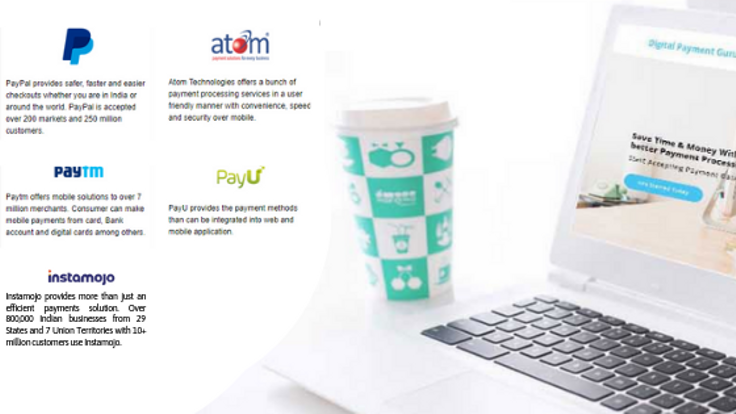
Digital Payment Guru provides payment gateway integration service of the top payment gateways like PayPal, PayU, Instamojo, Atom and Paytm. If you are confused which payment gateway to choose from, Digital Payment Guru helps you choose the best payment gateway by analyzing your business requirement.

By switching to Digital Payment Guru, you unload your task of choosing the best payment gateway to us.

How we can help?

Following are some of the features that can help you collect online payment:

  • Payment links: The most simple way to accept payments online is by creating a payment link. There is no rocket science in creating a payment link. You just have to click on create payment link in your payment gateway dashboard and set the amount for payment link, now you can share this payment link on multiple platforms like social media, mail, and messages and more.

Related Post: Everything you need to know about payment links.

  • Request bulk payments: Using the payment gateway dashboard you can send multiple payment requests to your client in one click and your client will receive a payment link by clicking on which they can make payment with multiple payment modes.
  • Faster Payout: As mentioned earlier, online payment requires a certain time to reflect on your bank account. Using Instant payouts you will receive payment from a client on time as well as the amount will be reflected in your bank account the same day.
  • Invoice Generator: Get the invoice for all the payments you receive from your clients. This can help you track and manage your payments in the future.

Payment Gateway for freelancers facilitated a clear communication between you and your client, Digital Payment Guru just acts as Payment Gateway provider who integrates a payment gateway into your system (website) and rest is on you, you have to use the dashboard to handle your payments. A payment gateway automates your payment collection process so that you can focus more on your business.


online payment

Accept Online Payment without Website.

Digital India initiative aims to bring digital empowerment to India. This transition can make India a knowledgeable economy. With the Digital India initiative, Small and Medium Enterprises have seen a higher growth rate over the last decade.

India currently has 48 million SME’s, yet there are a handful of small businesses having a website for their business despite the growth in technology. No matter how small your business is, having a website is very beneficial when it comes to modern-day marketing and exposure.

The need for Website & the cost

For Small and Medium enterprises, mentioning their service or products online on their website to reach more customers is more important than a payment gateway solution.

  1. Professionalism: Having a website creates a healthy impression on people and helps you to establish your brand as a professional service. Without a website, people will not be able to recognize your products or services because they cannot be found online.
  2. Increase Customer Reach:The number of people shopping online has grown over the years. From electronic devices to food and services, people prefer buying everything online because of the convenience and ease. As the website can be accessed from anywhere and anytime, make your business available 24/7. Since more customers are available online, your business reach will increase allowing your business to grow globally.
  3. Cost-Effective: Your website remains active throughout the time which means your website is marketing your products and services when you cannot directly.

On the other hand, for micro to small businesses managing and maintaining a website can burn holes in the pocket. Also, their business plan and financial budget will be affected before they start to run the business.

Also, with a website, there is a need for payment gateway integration into your website to start accepting payments from your customers online. 

We at Digital Payment Guru understand the problem and come up with the payment gateway solution at the best rates. We aim to help micro-businesses to grow by having a website.

How Digital Payment Guru can help?

top payment gateways

We have a wide range of Payment Gateways using which you can start accepting online payments without the need of having a website. Below mentioned are some of the products provided by our payment gateway:

  1. Web Store: You can create products like the subscription model, event tickets, electronic products, and more with an integrated payment gateway eliminating the need to create and maintain your website. You can share your website link with your customers or on social media.
  2. Payment Links: Payment links are smart online payment solutions for businesses having no website. You can create a payment link easily and share the link through multiple platforms like social media, messages or emails, and more. There are two types of payment links:
  • Pay: It allows the customer to enter the amount and personal details to make the payment. The customer can make payment with multiple payment modes and the amount will be credited into their account instantly.
  • Pay: It allows you to create a payment link with a fixed amount and share it with the customer on different platforms like social media, chat, emails, and more. Customers can make payments with multiple payment modes and the amount will be credited to their account instantly.
  1. Bulk Payment Link:  This is the payment link that can be shared across the customer base wherein you have to select the customer base and the link will be shared with all the customers present in the customer base at once. It avoids the hassle of sending the payment link to individual customers. Once the link is shared the customers will be directed to the payment gateway page to complete the payment and the amount will be credited into their account instantly.

Digital Payment Guru eliminates the need of having a website and provides a cost-effective online payment solution for MSMEs intending to help them grow.


5 Trending Low Investment Businesses.


Starting an online business is very much easier compared to putting up an office, hiring people, and starting a business which also consumes a lot of investment. The investment is the primary factor of this blog, we are going to discuss how you can invest less and start earning more without much of a hassle. 

When you think of starting a business online, the word online itself expands the idea as to which online business you should start up. Whichever business you start online the scope of business increases automatically with the word online. If you think of starting an online business and feel ambiguous, sit relaxed this blog is for you.

We are listing these 5 top trending online businesses you can start now with low investment. 

  1. Online Digital Courses: If you are good in a particular field and want to teach others, make tutorial videos, e-books, training books, webinars, and more on your website. There are various tools online using which you can make your e-book videos. Once you are done with creating the videos or e-books start selling them online. You will need a payment gateway integrated into your website to start accepting payments. The course you are selling can be in part or one-time payment depending on the length of your content. You can also sell your e-book or content on other e-commerce sites for more reach and popularity.
  2. Online Marketing Service: Marketing doesn’t require a huge knowledge of tools, market knowledge is what you need to start online marketing services. This is the most trending online business in 2019 as all the businesses out there require online marketing of their products because of the increase in competition. Marketing service is the business that will never go down as companies cannot succeed without marketing their products or services so they won’t run out of clients. To start this business you can own a static website that google provides for free wherein you can list down all your marketing services with rates. Or you can get a dynamic website built from Ouriken-at an affordable price and start accepting payments online with a payment gateway solution for your business.
  3. Content Writing: If you have an interest in writing this is the business you can start easily with very low investment. Companies mostly hire content writers to have quality content for their websites to get a higher SEO. Your client can also be students who start a new business and require content for their website. To expand your business you can create an account on freelancing sites or blogging sites. If you see an increase in demand add more members to your team and offer more services like copywriting, proofreading, blogging, magazine writing, and more.
  4. Click and Sell Photos: If you are passionate about photography, this passion can get you money by selling your photos online. Many people are willing to pay for good and unique photos that are of their use. You can also upload your photos on Shutterstock which is a trusted photo-selling site. You can also upload your photos on your website.
  5. Travel Agent: There are many travel agents out there selling travel packages at the best rates, you can start a business as a travel consultant displaying the agents with the best rates to the people so that they do not have to hop from one site to another. The business idea is that get all the information under one roof and show the best offer to the people or you can start your travel service.

Related Post: How to start an Online Business?

In the world of online business, there are many low-investment business opportunities. All these ideas will never scratch your pocket but can only be a secondary source of income. With all the marketing in the place payment gateway is something you will need as you are running an online business. Having a payment gateway will help you retain more customers. 

Digital Payment Guru provides payment gateway integration services of top payment gateways like PayPal, Paytm, PayU, Instamojo & Atom at the best market rates. If you are confused about which payment gateway to choose from, we can help you choose the best payment gateway for your business by analyzing your business requirements.


UPI 2.0

UPI 2.0


When it comes to online payments, UPI plays a vital role as it has become the most convenient mode of payment and is adopted by the majority of businesses. Post-demonetization, UPI-based payments have soared in India. According to the report of Inc 42, UPI has seen a massive payment processing hike of about 245 million in the span of 2 years.

UPI has also seen a growth of 78% in the number of banks integrating with it. UPI became the most popular and the most preferred mode of payment because of the following reasons:

  1. Money can be transferred 24/7.
  2. The UPI id acts as an email address for your money which can be shared to receive a payment instead of bank details.
  3. Increase in security.


NPCI is the organization that handles all the retail payments in a country. UPI is managed by NPCI. An updated version of UPI which is UPI 2.0 was launched by NPCI in August 2018 with the following new features:

  1. Link Overdraft Account: With the existing support for linking savings and current accounts, now you can link your overdraft account to UPI. Customers can make transactions easily and can avail themselves of all the benefits of an overdraft account. UPI 2.0 has become an additional digital channel for accessing your overdraft account.
  2. One-Time Mandate: UPI mandate can be used in the scenario where money can be transferred later with the commitment at present. Onetime block functionality for transactions is used for creating UPI mandates. Customers can authorize the transaction earlier and can make the payment later. It works for both customers as well as for merchants. Mandates can be created and executed instantly. On the date of the actual purchase, the amount will be automatically deducted and received by the merchant/individual user. 
  3. Invoice in the box: This feature is designed so that customers can check the invoice before making the payment. It will help the customers to view and verify the credentials and also check if it has come from the right merchant. Customers can pay once they have finished validating the details. 
  4. Signed Intent/QR code: This feature allows the customers to check the authenticity of the merchant by scanning the QR code. It notifies the customer with the information about the merchant stating whether he is a verified UPI merchant or not. Customers will be notified in case the merchant is not verified by the UPI merchant.

With its new features on offer, UPI 2.0 has a lot on offer. From a consumer’s point, UPI can be used to book taxis, pay for medicines at pharmacies, pay for groceries, or pay for investments a lot more. The increased popularity of UPI will reduce the market for wallets.

Digital Payment Guru provides payment gateway integration services of top payment gateways like PayPal, Paytm, PayU, Instamojo & Atom at the best market rates. If you are confused about which payment gateway to choose from, we can help you choose the best payment gateway for your business by analyzing your business requirements.


Reasons for Online Payment Failure.

Digital Payments in India have started becoming a primary platform for businesses to make and receive payments for the services they provide. With the development of Internet Technology, there is an increase in the scope for digital payments. Customer who makes an online transaction through any mode of payment has an immense amount of trust in digital payment, in this case, payment failures can be frustrating as putting their bank details online is not a joke.

Payment failures can happen because of an error on the user’s side, it can also be called an incomplete payment. Error at the user end can be incorrect card details, incorrect OTP, or insufficient funds in the user’s account.

Consider an example, Son wants to make an online transaction and he chooses the debit card option to make the payment. The debit is registered with his dad’s details and to authenticate the transaction an OTP will be sent to the registered number which belongs to his dad. The OTP needs to be entered within 15 minutes failed to do so the transaction will be timed out and will be considered an incomplete transaction.

Payment Processing:

The payment processing takes place in the following way:


When a customer makes a payment, there are several steps that are executed while transferring the payment to the merchant. Even a single glitch between these steps can cause payment failure. In the entire payment process where the customer, merchant, and banks are involved, failure at any one end can cause payment failure.

The payment failure can be caused due to:

  1. Bad Internet Connection: For the transaction to execute successfully a stable internet connection is necessary. If the internet is fluctuating, the payment process is affected, and closing the payment window during the process can cause payment failure or incomplete failure.
  2. Authentication Failure: Entering the wrong card details causes Authentication failure. Sometimes the OTP is not received on time and the session is timed out, this can cause incomplete payment. Online payment requires the user to enter things manually which is time-consuming at times and also increases the chances of wrong input.

Following errors occur for the transaction failure:

  1. The transaction cannot be authorized: If the password or OTP is wrong.
  2. Signature validation failed: When the 3d signature is wrong. A 3d signature is used by the buyer to validate the transaction made by the user.
  3. Payment not captured: Due to insufficient balance in the account or due to incorrect CVV.

 For Example: If you are making a net banking transaction, there are two passwords for the entire process. 1st password if for login into the net banking portal and the other is for authenticating the transaction. If even one password is wrong the transaction is failed. This is similar to the manual error that occurs during UPI payments or card payments. The amount is not deducted from your account and you receive a message that “payment cannot be processed”.

  1. Technology Failure: Online payment process has several steps for the merchant to receive payment from the customer for his products or services. (issuer bank, acquiring bank, payment gateway). While proceeding with the payment you need to choose the payment mode like Credit/Debit card and fill in the details. Once you finish filling up the details the data is sent to the payment gateway system which then transfers the data to a bank associated with a card. Bank creates requests with payment systems like visa or master card depending on the card used. These payment systems check if the customer has the required amount on balance to pay for the purchase, if yes the bank directly connects with the merchant and the amount is transferred to the merchant’s account within several days. Failure at even one step can cause payment failure.
  2. Downtime: If there are several transactions happening through the system and the payment gateway is unable to reach the customer’s bank to approve the transaction, the payment fails. Downtime of the issuer, acquiring bank or payment gateway of the merchant can cause payment failure.
  3. Security: Issuing bank has an aggressive fraud detection technique that blocks transaction that they feel are not normal to customers spending behavior. This is done by analyzing the transaction history of the customer and the transaction is blocked If it doesn’t conform with the customer’s past spending behavior.

There is no worry if the amount is deducted from your account on payment failure. Your amount is going nowhere, it will be refunded to your bank account after the bank analyses exactly which step the payment process failed.

To know Why Do Payment Transactions Fail On An E-Commerce Site? – click here

Digital Payment Guru provides payment gateway integration services of top payment gateways like PayPal, Paytm, PayU, Instamojo & Atom at the best market rates. If you are confused about which payment gateway to choose from, we can help you choose the best payment gateway for your business by analyzing your business requirements.

Payment Gateway features you can use to grow your business.


If you are running a business and thinking of growing it, a payment gateway is something you should definitely think of. Payment Gateway Integration is very much beneficial for businesses nowadays as it has certain features than can help you grow your business. In this blog, let’s discuss these features and how it can benefit you.

  1. Recurring Payments: The most hectic task for any business is to collect repeated payments. The recurring Payments feature helps you manage repeated payments easily. You can ask your customers to subscribe to recurring payments. Once set up, you don’t need to send payment reminders to your customers, the amount will be deducted from customers’ accounts on a fixed date every month and transferred to your account automatically.
  2. International Payments: If you plan to expand your business globally, Payment Gateway can help you collect payments from around the globe. Expanding your business globally can help you increase your business reach and generate more revenue. Payment Gateway provides multi-currency support as customers would want to come back if they can make payments in their own currencies. 
  3. Same-Day Settlements: Small Businesses rely on daily sales to manage their cash flow and plan out things accordingly. As merchants have to wait for the amount to be reflected in their bank account from the merchant account it becomes difficult for them to manage the cash flow. Same day settlement feature helps you get the money into your bank account on the same day when the customer makes payment. Thus having a payment gateway can help you manage your cash flow and plan out things accordingly.
  4. Payouts: If you are running a business at times it can happen that you might get very much busy with work and forget to release the payments to different accounts and by the time you realize bank hours are over and all that you can do is wait for the next day to make the payouts. With the Payouts feature, you can not only send bulk payments to different accounts using various online payment options but also track the payment and download the transaction reports at the same time. This can help you manage payments and grow your business.
  5. Update bank account yourself: If you ever wish to change the bank account, there is no need for you to worry about uploading the documents again or calling customer care, you can simply update it by logging into your payment gateway account and updating the bank details and you are good to go.
  6. Customer Service: Customer Service plays a vital role in the online payment cycle. It assists your customer if they are stuck in between payment processes or have any queries related to payments. Customer service can also help you with customer retention.

Related Post: How to start Online Business.

With the Integration of Payment Gateway into your website, you can automate your payment procedure and increase your business reach which can help you grow your business.

Digital Payment Guru provides payment gateway integration services of top payment gateways like PayPal, Paytm, PayU, Instamojo & Atom at the best market rates. If you are confused about which payment gateway to choose from, we can help you choose the best payment gateway for your business by analyzing your business requirements.


Recurring Payment

Everything You Need To Know About Recurring Payments


If you are offering a product or a service for which you want to charge your customers on a repeated basis, recurring payments are something you should opt for. It is a convenient option that your customers do not have to remember to pay for your products or services. Using recurring payments allows you to sell your products and services automatically. Checkouts are optimized to make it easier to predict the cash flow.

What are Recurring Payments?

Recurring payments are repeated payments, you are charged automatically for the products or services you are subscribed to and charged on a fixed interval. It can be for a specific period of time depending on the business model. The whole process is initiated by card authorization in the following steps:

  1. The recurring payment option is selected by the customer on your website.
  2. Now they need to accept the terms and conditions for authorization.
  3. Once authorized they need to provide their card details and confirm the payment, now the customer will be charged at fixed intervals until they choose to cancel the subscription.


For Example, if You have subscribed to a broadband connection on a monthly basis, and you renew your broadband service every month, instead of doing that you can choose the recurring payments option on their website. Now the amount will be automatically deducted from your account every month and your subscription will be renewed automatically.

Related Post: Recurring Payment via UPI or Credit cards?

Advantages of Recurring Payments for Merchants:

  • Monitor Cash Flow:  The merchant can monitor the average cash flow that is being credited into his account which can help him build a strategy for the future.
  • Fewer Missed Payments: As the payments from customers will be automated, the merchant does not have the hassle of sending payment reminders to his customers thus saving time and money.
  • Reduced Processing fees: As the recurring payments are done online, the extra cost required for cheque payments will be avoided.
  • High Customer Retention: If the customer wants to stop the recurring payments they need to cancel the subscription which is most likely not going to happen.

Advantages of Recurring Payments for Customers:

  • Avoid Late Fees: Many businesses charge a penalty for late fees which can be avoided using recurring payments as the amount is automatically debited after a fixed interval without having to remember. They are most beneficial for those who travel a lot and do not have time for renewals.
  • User Convenience: Once the customer has opted for recurring payments, they do not need to log in again to make a payment, the payments will be done automatically after the fixed interval for the products or services.
  • Manageable Spending: If a customer wants to buy an expensive product and he doesn’t have enough balance in his bank account, he can split the amount into multiple billing cycles with recurring payments.
  • Quick Payments: Use of a cheque payment is time-consuming as it takes some days for the amount to reflect in the merchant’s account at the same time you have to stand in the queue for making a cheque payment. Whereas recurring payments are online payments and the amount is reflected immediately into the merchant account at the same time automation is what makes recurring the preferable option over a cheque payment.
  • Environmental Saving: Recurring payments are digital payments and are an alternative to paper-based payments like a cheque. Recurring payments have no paper billing, everything is digital in recurring payments thus saving the environment.


For a recurring payment, the subscription model works best for large merchants with multiple products. Recurring payments are game-changers, you need to rethink as to what works best for your customers.

Digital Payment Guru provides payment gateway integration services of top payment gateways like PayPal, Paytm, PayU, Instamojo & Atom at the best market rates. If you are confused about which payment gateway to choose from, we can help you choose the best payment gateway for your business by analyzing your business requirements.


Payment System Evolution – Then & Now.


Money is simply a medium of exchange as well as a store of value. when it comes to knowing how the payment system changed its face from past to present I would like to share some important points which need to be noticed.

BARTER SYSTEM

In the beginning, people bartered. Bartering is the exchange of a good or service for another good or service. For example, if any milkman wants grains he can exchange his milk with a farmer for grain. However, what if you couldn’t agree on what something was worth in exchange or you didn’t want what the other person had? Humans developed the concept of commodity money as a solution to their problems.  The commodity is a particular thing used by almost everyone. In ancient times items such as grains, tea, tobacco, cattle, and seeds were commodities and therefore were once used as money. However, using commodities as money had other problems. Carrying things in day to day manner was hard and commodities were difficult to store or were perishable.

DISCOVERY OF COINS

Cowrie shells were used as money in the Pacific in 1200 B.C. In China and some parts of Africa but other countries, animal skins were valuable things. China started to use metal in their money in 1000 B.C. They made metallic cowries using bronze and copper. Coins were used mostly in 500 B.C. in Lydian’s, coins were made using a mixture of gold and silver. & at the back, it stamped, and with precious metals as core material, the coin had significant value.


CHINA DISCOVERS PAPER MONEY

Paper money started to appear in China near about 806 A.D. because of shortages in copper. During the 1600s, banknotes started in England. Money was exchanged for gold. Gold became an important value in England In the year 1816. In 1661 Swedish Stockholm Bank was the first bank in Europe to issue printed money.

EUROPEANS & BANKNOTES

Till the 16th century Europeans were using coins, helped along by acquisitions of precious metals from colonies to keep minting more and more cash. Eventually, the banks started using bank notes for depositors and borrowers to carry around instead of coins. These notes could be exchanged in a bank at any time to change their face values in silver or gold coins. Paper money was mostly used to buy goods and operated as the main currency nowadays but it was issued by banks and private institutions, not the government is now responsible for issuing currency in maximum countries.

European governments issued the first paper currency colonial governments in North America. Europe and the colonies carried the Shipments business for so long, the colonists often ran out of cash as operations expanded., the colonial governments used IOUs that traded as a currency except for the barter system The first introduction of that was in Canada, then a French colony. Soldiers have issued playing cards denominated and signed by the governor to use as cash instead of coins from France near about 1685.

Related Post: How to start an Online Business?

THE WORLD DECIDES TO GO CASHLESS

In 1933 U.S. The gold standard completely stopped as a link between the dollar and gold in 1971, now USD value is not linked to any specific asset. In other words, the U.S. dollar can’t be considered real money. From then, paper money was used as a standard form of money, and in the 1960s, the first version of credit cards began to emerge. Developing nations are still learning about credit card usage.  It remains prevalent today and many countries especially Developed nations, on the other hand, are moving towards digital wallets and other digital payment platforms in their quest for a cashless that’s why coins or notes are convertible into precious metals, money of these forms is the check that, for simplicity of use and security offered, is being adopted by an increasing most of the people in their daily activities. With the support of this document which one can orders payment of a certain amount to its bearer or a person mentioned in it, aims mainly at transactions with bank deposits. One of these forms is the Cheque that, for simple use and security offered, is being adopted by a large number of people in their daily lives. Money became more dematerialized and assumed abstract forms.

To know how to secure international payments for your business click here.

INTERNET & MONEY

In the second part of the twentieth century, computer technology allowed money to be represented digitally. In the United States, all money transferred between its central bank and commercial banks was electronically near 1990. In the year 2000, most money existed as Digital currency in bank databases. In 2012, by several transactions, 20 to 58 percent of transactions were electronically dependent on the country. Non-national digital currencies were developed in the early

PAYMENT GATEWAY

In the 21st century to two new forms of currency came into use. Mobile payments and virtual currency. Mobile pay is money rendered for a product or service through a portable electronic device such as a cell phone, smartphone, or tablet. Now a day’s Mobile payment technology is used to send money to friends or family members. A new technology of online payment arrives.  It enables a merchant to collect money from the customer. It verifies the information provided by the user and the payment method and then authorizes the transaction. Payment Gateway Integration manages your marketplace, automate money transfer, and collect frequent payments all from a single platform. It Accepts all payment method-Credit card, Debit card, Net Banking, UPI, and more. We offer the best payment gateway tools PayPal, Paytm, Instamojo, Atom payment solutions, and PayU. Payment Getaway Manage your marketplace, automate money transfer, and collect frequent payments all from a single platform. It Accepts all payment method-Credit card, Debit card, Net Banking, UPI, and more. We can help you choose the best payment gateway for your business by analyzing your business requirements.

With the evolution of payment, security measures also need to evolve. Today, companies have adopted several security measures to provide a secure and better payment experience to their customers to avoid the risk of online fraud. Digital Payment Guru is one of them that provides top payment gateways that are PCI-DSS compliant and at the best market rate.