UPI Complete Guide

UPI Complete Guide: Choosing the Right Payment App

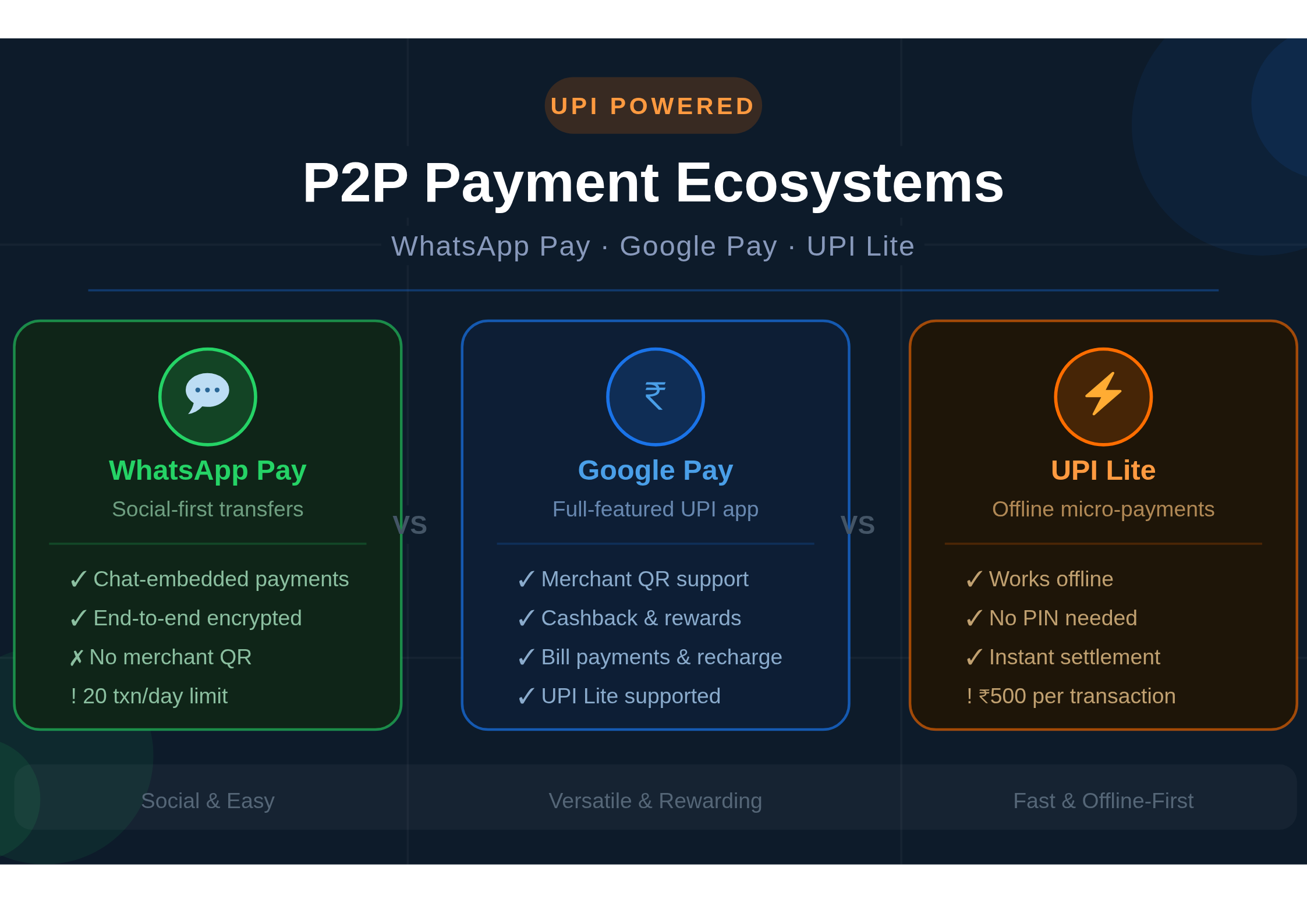
Digital payments in India have gone from a novelty to a necessity. Today, millions of people send money to friends, pay shopkeepers, and split bills — all within seconds, right from their phones. Three platforms stand at the center of this shift: WhatsApp Pay, Google Pay, and UPI Lite. Each one brings something different to the table. So, which one actually deserves a spot on your home screen?

In this blog, we break down these three P2P payment ecosystems side by side. Whether you care about speed, security, offline access, or just ease of use — this guide covers it all.

UPI Complete Guide

What Is a P2P Payment Ecosystem?

Peer-to-peer (P2P) payments allow users to transfer money directly from one bank account to another — no middleman, no waiting, no paperwork. In India, the Unified Payments Interface (UPI) powers most of these transactions. It is built and regulated by the National Payments Corporation of India (NPCI).

Therefore, apps like WhatsApp Pay and Google Pay do not move money on their own. Instead, they ride on top of the UPI infrastructure. UPI Lite, however, is a distinct layer that handles smaller, low-value transactions differently. Understanding this difference is key to choosing the right tool.

Google Pay: The Power Player

Google Pay (formerly Tez) launched in India in 2017. It quickly became one of the most downloaded UPI apps in the country. Even today, it holds a massive market share — and for good reason.

Key Features

Google Pay supports multiple UPI IDs and bank accounts. Users can link up to four bank accounts at once. Consequently, switching between accounts during a payment is easy. The app also supports bill payments, mobile recharges, and merchant QR code scanning.

Moreover, Google Pay uses a layered security model. Every transaction requires a UPI PIN. The app also features a “Safe” area that hides your payment history and account details behind an extra lock. This gives cautious users an added sense of control.

Additionally, the Nearby feature lets users discover and pay nearby businesses quickly. The rewards program — with scratch cards and cashback offers — has long been a crowd-pleaser. Furthermore, Google Pay integrates neatly with other Google services like Gmail and Google Assistant.

Limitations

On the downside, Google Pay requires internet access for every transaction. It also does not support in-app chat or social features. For users who want a more all-in-one experience, this can feel limiting.

WhatsApp Pay: The Social Payment Shortcut

WhatsApp Pay entered the Indian market after a long regulatory battle. Launched fully in 2020, it is now available to over 500 million WhatsApp users in India. The core idea is simple — pay someone directly inside a chat window.

Key Features

WhatsApp Pay is deeply embedded in the messaging experience. To send money, you simply open a chat, tap the attachment icon, and select Payment. As a result, paying someone feels as natural as sending a sticker or a voice note.

The platform supports all major Indian banks and uses UPI for fund transfers. Notably, it also stores transaction history within the chat thread — so you always know who paid whom and when. This makes it especially useful for splitting expenses among friends or family.

From a security standpoint, WhatsApp Pay is compliant with NPCI’s data localization norms. It uses end-to-end encryption for messages and a separate UPI PIN for payments. Nevertheless, some privacy advocates remain cautious about Meta’s data practices.

Limitations

WhatsApp Pay currently caps total UPI transactions at 20 per day, which is lower than Google Pay. It also lacks support for merchant QR codes at the moment. Similarly, advanced features like scheduled payments or bill splitting tools are absent. Still, for casual money transfers within a social circle, it is hard to beat.

UPI Lite: The Offline Game-Changer

UPI Lite is not exactly an app — it is a feature within UPI-enabled apps. Launched by NPCI in 2022, it addresses one of the biggest pain points of digital payments in India: poor network connectivity.

How It Works

UPI Lite works by pre-loading a small amount of money — up to ₹2,000 — into an on-device wallet. From there, you can make payments of up to ₹500 per transaction without needing internet access or a UPI PIN. Each transaction settles instantly on the device, and bank reconciliation happens later in the background.

Consequently, UPI Lite is perfect for small, everyday purchases — a chai at a roadside stall, a newspaper, an auto-rickshaw fare. Because it skips the usual server verification step, transactions process much faster than standard UPI payments.

Availability

Currently, UPI Lite is supported within Google Pay, Paytm, and several bank apps. WhatsApp Pay does not yet offer UPI Lite support, which is a notable gap. However, NPCI plans to expand compatibility across more platforms in the near future.

Limitations

The wallet cap of ₹2,000 limits its use for higher-value transactions. Additionally, users must manually top up the wallet, which can be a minor inconvenience. That said, for micro-transactions in low-connectivity areas, UPI Lite is a genuine breakthrough.

Head-to-Head Comparison

Here is a quick snapshot of how the three platforms stack up against each other:

Feature Google Pay WhatsApp Pay UPI Lite
UPI Support ✅ Full ✅ Full ✅ Lite Only
Offline Payments ❌ No ❌ No ✅ Yes
Social Integration ❌ Limited ✅ Strong ❌ None
Merchant QR ✅ Yes ❌ No ✅ Yes
Transaction Limit ₹1 Lakh/day ₹1 Lakh/day ₹500/txn
Daily Txn Count Unlimited 20 per day Unlimited
PIN Required ✅ Yes ✅ Yes ❌ No
Cashback/Rewards ✅ Yes ❌ Limited ❌ No

Security: How Safe Is Your Money?

Security is a top concern for any digital payment user — and rightfully so. Fortunately, all three platforms operate under RBI and NPCI guidelines, which means they follow strict data handling and fraud prevention standards.

Google Pay uses device-level security, including fingerprint and face recognition. WhatsApp Pay benefits from end-to-end encryption at the messaging layer. UPI Lite, meanwhile, removes the PIN requirement for small transactions — which speeds things up but also shifts responsibility to the user. Therefore, always keep your phone locked when not in use.

Regardless of which app you use, never share your UPI PIN with anyone. Be cautious of collect requests from unknown contacts. And always verify the recipient’s name before hitting confirm.

Which One Should You Use?

The best P2P payment app depends entirely on your lifestyle and needs. Here is a simple breakdown:

Choose Google Pay  if you want a full-featured UPI app with cashback rewards, bill payments, and merchant support. It is the most versatile option overall.

Choose WhatsApp Pay  if you frequently transfer money to friends and family who are already on WhatsApp. The conversational payment flow is smooth and social.

Use UPI Lite  if you make lots of small, everyday payments and live in an area with spotty internet. It is the fastest and most friction-free option for micro-transactions.

In practice, many users rely on more than one. For example, you might use UPI Lite for buying street food, Google Pay for utility bills, and WhatsApp Pay to split dinner with friends. There is no rule that says you must pick just one.

The Future of P2P Payments in India

India’s digital payment sector is growing at a breakneck pace. UPI processed over 13 billion transactions in a single month in 2024. As a result, competition among payment apps is intensifying. Going forward, expect to see smarter AI-driven fraud detection, expanded UPI Lite limits, and deeper integration with e-commerce platforms.

WhatsApp Pay is likely to roll out merchant payment features as Meta expands its Commerce ecosystem in India. Similarly, Google Pay is investing heavily in credit products and BNPL (Buy Now Pay Later) integrations. Meanwhile, NPCI is working on UPI One World — a version designed for foreign visitors to India.

Ultimately, the winner of this race will not be determined by features alone. Trust, simplicity, and network reach will decide which app becomes the default choice for the next billion users.

Final Thoughts

P2P payments are no longer just a convenience — they are the backbone of everyday financial life in India. WhatsApp Pay brings payments into conversations. Google Pay brings rewards and versatility. UPI Lite brings speed and offline access to places that were previously left out. Each platform has carved out its own niche. Together, they are reshaping how a billion people think about money. So go ahead — try all three, see what fits, and take full advantage of India’s world-class digital payments infrastructure.

Read More:

Everything You Need to Know About Payment Gateway Before Launching Your Subscription Box

Regulatory Sandboxes for Fintechs: Opportunities & Risks in India

How Offline payments Secure the Local Economy?

Everything You Need to Know About Payment Gateway Before Launching Your Subscription Box

Everything You Need to Know About Payment Gateway Before Launching Your Subscription Box

India’s subscription box market is booming. From beauty products to books, pet care to gourmet snacks — more Indian consumers are signing up for curated monthly boxes than ever before. But here’s the thing. Running a subscription box business is not just about great packaging or handpicked products. It’s also about getting paid — reliably, automatically, and on time, every single month. That’s exactly where a payment gateway becomes your most important business tool.

In this guide, we’ll walk you through everything you need to know. So, whether you’re just starting out or scaling fast, you’ll find the right payment solution for your subscription brand.


Why Payment Gateways Matter More for Subscription Boxes

First, let’s understand why this topic deserves special attention.

A standard e-commerce business collects a one-time payment. Simple. But a subscription box business collects recurring payments — weekly, monthly, or quarterly. That changes everything.

You need a gateway that supports:

  • Automatic recurring billing
  • Failed payment retries
  • Subscription plan management
  • Smooth UPI and wallet integration
  • RBI-compliant e-mandate flows

Without these features, you’ll spend hours every month chasing payments manually. That’s not scalable. And it’s certainly not how successful brands operate.


Understanding How Recurring Payments Work in India

Before picking a gateway, it helps to understand the rules.

The Reserve Bank of India (RBI) introduced e-mandate guidelines for recurring transactions. Under these rules, customers must give explicit consent before auto-debits happen. For transactions above ₹15,000, additional authentication is required each time.

This framework protects customers. But it also means your payment gateway must be fully compliant with these regulations.

Fortunately, the top gateways in India have already built this into their systems. So, as long as you choose wisely, compliance won’t be a headache.


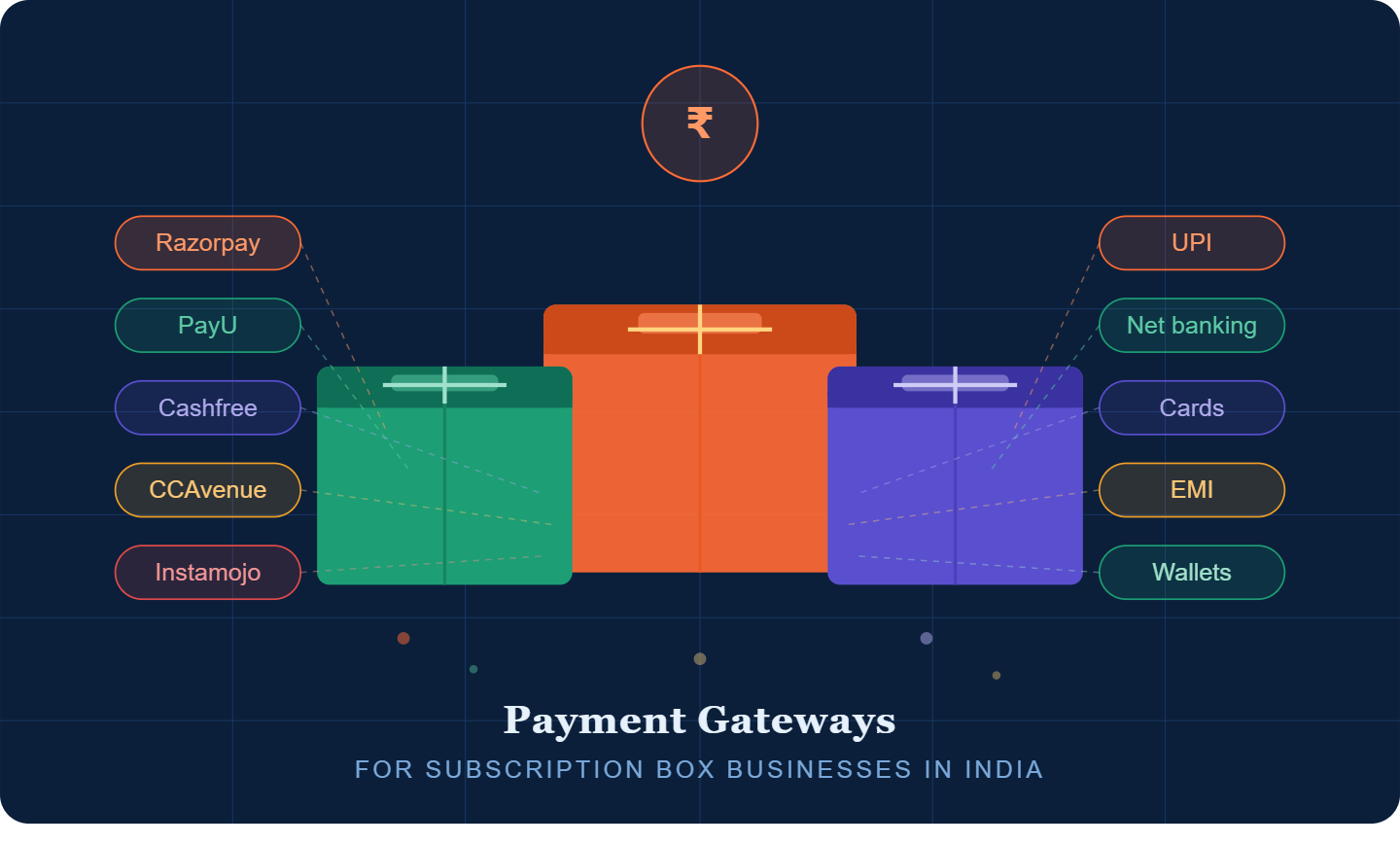
Top Payment Gateways for Subscription Box Businesses in India

Everything You Need to Know About Payment Gateway Before Launching Your Subscription Box

Now, let’s get into the real comparison.

1. Razorpay — Best Overall for Subscription Businesses

Razorpay is arguably the most popular choice among Indian D2C brands. And for good reason.

It offers a dedicated Subscriptions API that lets you create flexible billing plans easily. You can set weekly, monthly, or annual cycles. Moreover, Razorpay handles failed payment retries automatically — a feature that dramatically reduces churn.

It also supports UPI AutoPay, which is a big deal in India right now. UPI AutoPay lets customers set up auto-debits without needing to enter their card details. This increases sign-up conversions significantly.

Additionally, Razorpay’s dashboard gives you clear visibility into active subscribers, upcoming renewals, and failed transactions. For growing brands, that kind of data is gold.

Transaction fees start at around 2% per transaction. For high-volume businesses, they offer custom pricing.

2. PayU — Great for Established Brands

PayU is another strong contender. It’s been in the Indian market for years, so its reliability is well-established.

PayU supports recurring billing through its subscription management tools. It also integrates smoothly with most popular e-commerce platforms like WooCommerce, Shopify, and Magento.

Furthermore, PayU offers one of the widest coverage of banks for net banking. This is useful if your customer base skews toward older demographics who prefer traditional banking over UPI.

However, PayU’s interface is not as modern as Razorpay’s. That said, its backend stability makes it a trusted choice for businesses processing higher volumes.

3. Cashfree Payments — Best for Fast Settlements

If cash flow is a priority — and for most small subscription brands, it absolutely is — then Cashfree deserves serious attention.

Cashfree offers same-day and next-day settlement options. That means the money your customers pay today can be in your account by tomorrow. For businesses with tight operating margins, this makes a real difference.

Cashfree also has strong subscription billing capabilities, including support for UPI AutoPay and e-NACH (electronic National Automated Clearing House) mandates. Its API is clean and developer-friendly, too.

In terms of pricing, Cashfree is competitive and transparent. It also offers a free plan for early-stage startups — something worth noting if you’re just launching.

4. CCAvenue — Best for Multiple Payment Options

CCAvenue has one of the widest arrays of payment options among Indian gateways. It supports over 200 payment modes. These include all major credit and debit cards, UPI, net banking across 58+ banks, EMI options, and digital wallets.

For subscription box businesses targeting a broad customer base — including tier 2 and tier 3 cities — this kind of coverage matters. Not everyone in India uses UPI or has a premium credit card. CCAvenue fills those gaps effectively.

Its recurring billing feature handles automated deductions. Moreover, it provides multi-currency support, which is useful if you plan to expand internationally.

One downside is that CCAvenue’s onboarding process can be slower compared to Razorpay or Cashfree. But once it’s set up, it’s a solid, stable platform.

5. Instamojo — Best for Small and Early-Stage Businesses

If you’re just starting your subscription box journey, Instamojo is worth exploring. It’s simple to set up. It requires minimal technical knowledge. And it’s designed specifically for small Indian businesses.

Instamojo lets you create payment links and basic subscription plans without writing a single line of code. So, for solopreneurs or bootstrapped founders, it offers a low-barrier entry point.

That said, it’s not ideal for high-volume or technically complex subscription models. As you scale, you’ll likely need to migrate to a more robust platform.


Key Features to Look for in a Subscription Payment Gateway

Beyond brand names, here are the features that truly matter when evaluating any gateway:

Recurring billing support. This is non-negotiable. Make sure the gateway handles automatic renewals without manual intervention.

RBI e-mandate compliance. Your gateway must support the latest RBI guidelines for recurring debit transactions. Non-compliant gateways create legal and operational risk.

UPI AutoPay integration. UPI is India’s dominant payment rail. AutoPay on UPI removes friction from the subscription sign-up process.

Retry logic for failed payments. Every subscription business deals with failed payments. Smart retry logic — where the system automatically reattempts the charge — dramatically reduces involuntary churn.

Webhook and API access. If you use a custom platform or CRM, you’ll need clean webhook support to sync payment events in real time.

Transparent pricing. Hidden fees eat into margins. Always read the fine print before committing to a gateway.


Common Mistakes to Avoid

Even experienced founders make avoidable payment mistakes. Here are a few to watch out for.

Many businesses underestimate failed payment rates. On average, 5–10% of recurring payments fail each cycle due to expired cards, insufficient funds, or bank issues. Without a retry mechanism, that’s revenue lost permanently.

Another common mistake is ignoring the checkout experience. A clunky, slow, or unfamiliar payment screen kills conversions. Always A/B test your checkout flow.

Finally, some brands delay setting up proper e-mandates. If you launch recurring billing without proper mandates in place, you risk RBI non-compliance — and that can freeze your payment processing entirely.


Which Gateway Should You Choose?

Here’s a quick way to think about it.

If you want an all-round solution with great subscription tools and UPI AutoPay, go with Razorpay and if cash flow is critical and you want fast settlements, choose Cashfree. But if you serve a wide, diverse customer base across India, CCAvenue covers more payment options or if you’re a small brand just starting out, Instamojo is the simplest entry point.

Ultimately, there’s no single right answer. The best payment gateway is the one that fits your business stage, tech stack, and customer base.


Final Thoughts

Running a subscription box business in India is exciting. The market is growing. Consumers are warming up to the model. And the tools available to founders today are better than ever.

But none of that matters if your payments fail, your billing is broken, or your customers churn because the renewal process is frustrating.

Your payment gateway is not a background tool. It’s the engine that keeps your subscription business alive.

So, choose it carefully. Set it up properly. And revisit the decision as your business grows.

Because when payments work seamlessly, everything else becomes a little easier.


Found this guide helpful? Share it with a fellow subscription brand founder who’s still figuring out their payment gateway stack.


Read More:

Regulatory Sandboxes for Fintechs: Opportunities & Risks in India

How Offline payments Secure the Local Economy?

Building a Better finance Future with ESG Standards