Event-Driven Payment System: What You Need Full Guide

Event-Driven Payment System: What You Need Full Guide

Payments are getting faster. Customer expectations are rising. Traditional payment architectures are struggling to keep up. Event-driven payment systems offer a powerful solution. They are changing how fintech companies build and scale.

What Is an Event-Driven System?

An event-driven system reacts to events in real time. An event is any change in state — a payment initiated, a fraud alert triggered, or a balance updated. When an event occurs, the system responds immediately. There is no waiting for batch processing or scheduled jobs.

Furthermore, event-driven systems are asynchronous. Different services communicate through events, not direct calls. This makes them loosely coupled. Therefore, one service failing does not bring down the entire system.

Event-Driven Payment System: What You Need Full Guide

How Traditional Payment Systems Work

Legacy payment systems use synchronous, request-response models. A payment request goes in. The system processes it step by step. The response comes back only after all steps complete. This works for low-volume transactions. However, it breaks under high load.

Additionally, traditional systems are monolithic. All payment logic lives in one large codebase. Updating one part risks breaking others. Scaling requires scaling the entire monolith. Consequently, costs rise sharply as transaction volumes grow.

The Event-Driven Approach to Payments

In an event-driven payment system, every action publishes an event to a message broker. Popular brokers include Apache Kafka, RabbitMQ, and AWS Event Bridge. Downstream services subscribe to relevant events and act on them independently.

For example, when a user initiates a payment, the system publishes a Payment Initiated event. The fraud detection service subscribes and checks the transaction. Simultaneously, the ledger service records the pending transaction. Both happen in parallel.

Key Benefits of Event-Driven Payment Systems

Real-time processing: Payments complete in milliseconds, not seconds.

Scalability: Individual services scale independently based on load.

Resilience: Service failures do not cascade through the system.

Auditability: Every event is logged, creating a complete payment trail.

Flexibility: New services plug in without changing existing ones.

Core Components of the Architecture

A strong event-driven payment system needs several core parts. First, the event producer captures and publishes payment events. Second, the message broker routes events to the right consumers. Third, event consumers process events and trigger downstream actions.

Additionally, an event store keeps a historical record of all events. This enables event sourcing — the ability to replay events to rebuild state. Therefore, recovery from failures becomes much simpler and more reliable.

Real-World Use Cases in Fintech

Buy Now Pay Later (BNPL): Events trigger credit checks, disbursements, and repayment reminders.

Cross-border payments: Events coordinate currency conversion, compliance checks, and settlement.

Digital wallets: Events sync balances across multiple accounts in real time.

Fraud detection: Events stream transaction data to ML models for instant scoring.

Subscription billing: Events trigger invoices, payment retries, and dunning workflows.

Challenges to Consider

Event-driven systems introduce new complexity. Event ordering can be tricky. If events arrive out of sequence, the system may process them incorrectly. Consequently, engineers must design for idempotency — processing the same event twice without side effects.

Moreover, debugging distributed event flows is harder than tracing monolithic code. Teams need robust observability tools. Distributed tracing tools like Jaeger or Zipkin help. Additionally, structured logging and centralized monitoring are essential.

Regulatory and Compliance Considerations

Fintech companies operate under strict regulations. Event-driven architectures must comply with PCI-DSS, PSD2, and regional payment laws. All events containing payment data must be encrypted in transit and at rest. Furthermore, audit trails must be immutable and accessible for regulators.

Interestingly, event sourcing actually helps compliance. Since every state change is captured as an event, regulators can see exactly what happened and when. Therefore, event-driven systems can be a compliance advantage.

How to Start Building an Event-Driven Payment System

i. Map your existing payment workflows and identify key events.

ii. Choose a message broker that fits your scale requirements.

iii. Define a clear event schema with versioning support.

iv. Start with a single payment flow, then expand gradually.

v. Invest in observability from day one.

The Future of Event-Driven Fintech

Event-driven architecture is becoming the standard for modern fintech. As real-time payment networks like FedNow and Open Banking expand, the need for event-driven systems grows. Companies that adopt this architecture now will be better positioned to serve future payment demands.

Moreover, AI is integrating with event-driven systems to create smarter payment intelligence. Events feed AI models that predict fraud, optimize routing, and personalize financial products. Consequently, event-driven payments are not just an architectural choice — they are a strategic one.

Final Thoughts

Event-driven payment systems represent the next major step in fintech evolution. They enable speed, scale, and resilience that legacy systems simply cannot match. For fintech companies aiming to compete in 2026 and beyond, event-driven architecture is no longer optional. It is the foundation of modern payment infrastructure.

Read More:

Reduce Payment Failures With These Simple Fixes

How Smart Payment Routing Logic Really Works: Complete Guide

AWS-SDK for Payments: What Businesses Must Know Full Guide

Reduce Payment Failures With These Simple Fixes

Reduce Payment Failures With These Simple Fixes

A failed payment is more than an inconvenience. It costs real money. Studies show that businesses lose billions each year to declined transactions. Many of these failures are preventable.

Understanding why payments fail is the first step. Once you know the root cause, fixing it becomes straightforward. This guide covers the most common technical reasons — and exactly how to address them.

Why Payment Failures Hurt More Than You Think

Every failed payment means a lost sale. Additionally, it damages user trust. A customer who faces checkout failure is unlikely to return.

Furthermore, high failure rates trigger penalties from payment processors. They may raise your fees or suspend your account. Consequently, fixing payment failures protects both revenue and reputation.

Reduce Payment Failures With These Simple Fixes

Category 1: Gateway and API Errors

Payment gateways act as the bridge between your platform and the bank. When this bridge has issues, transactions fail. Here are the most common gateway-level problems:

Timeout Errors

Timeouts happen when the gateway takes too long to respond. This can be caused by server overload, slow network, or misconfigured timeout settings. The fix: increase timeout thresholds and add retry logic with exponential backoff.

Invalid API Keys

Expired or incorrect API keys will block every transaction. This is a simple but surprisingly common issue. Always rotate keys securely and test in staging before going live.

SSL/TLS Certificate Issues

An expired SSL certificate breaks the secure handshake between your server and the gateway. Most gateways refuse connections without valid TLS. Therefore, set up auto-renewal for all certificates on your domain.

Category 2: Card and Bank-Side Declines

Not all failures come from your end. Banks and card networks decline transactions too. Understanding these codes helps you respond correctly.

Insufficient Funds (Code: 51)

This is the most common decline. The customer simply does not have enough balance. The fix here is clear communication. Show a helpful message and offer alternative payment options.

Do Not Honour (Code: 05)

This vague code means the bank rejected the transaction without a specific reason. It could be fraud suspicion, account restrictions, or a new card not yet activated. Prompt customers to call their bank or try a different card.

Card Expired (Code: 54)

An expired card triggers this code. Build in expiry date reminders if you offer subscriptions. Additionally, use card update services like Visa Account Updater to auto-refresh card data.

Velocity Limits (Code: 61)

Banks set transaction velocity limits per card per day. Large or repeated transactions may trigger this. Advise customers to contact their bank to temporarily increase their limit.

Category 3: Fraud Detection Triggers

Both banks and payment processors use fraud detection algorithms. Sometimes, legitimate transactions get flagged. This is called a false positive, and it is more common than most businesses realize.

Address Verification Failure (AVS Mismatch)

If the billing address entered does not match bank records, the transaction fails. The fix: make your address fields clear and well-labelled. Also, consider relaxing AVS rules for low-risk transactions.

CVV Mismatch

An incorrect CVV instantly declines the card. This protects against card-not-present fraud. Improve your UI to clearly prompt users to enter the three or four digit security code.

IP Geolocation Mismatch

If the user’s IP location does not match the card’s country, some systems flag it. VPN users trigger this often. Implement smart risk scoring instead of hard blocks based on IP alone.

Category 4: Integration and Code Issues

Technical bugs in your own code can break the payment flow. These are fully within your control and usually straightforward to fix.

Duplicate Transaction Detection

Submitting the same order twice triggers duplicate detection. This often happens when users double-click the payment button. Use idempotency keys to prevent duplicate submissions.

Malformed Requests

Sending wrong data types, missing fields, or incorrect formatting will fail validation. Review your API request logs regularly. Also, validate all form inputs client-side before submission.

Currency Mismatch

Charging in a currency your gateway account is not configured to accept causes failure. Check your gateway’s accepted currency list. Moreover, test multi-currency support thoroughly before launching in new markets.

Category 5: 3D Secure and Authentication Failures

3D Secure adds an extra authentication step. When implemented poorly, it creates friction that leads to cart abandonment.

Use 3DS2 instead of 3DS1 where possible. 3DS2 performs risk assessment in the background, reducing unnecessary challenges. Also, handle authentication failures gracefully with clear error messages.

Best Practices to Reduce Payment Failures

  1. Set up real-time payment failure alerts and dashboards.
  2. Log all error codes and map them to resolution action.
  3. Use a payment orchestration layer to route to backup gateways.
  4. Implement smart retry logic for soft declines.
  5. Test your checkout flow in multiple browsers and devices monthly.
  6. Partner with a card account updater service for subscription businesses.
  7. Display clear, friendly error messages — never show raw error codes to users.

How to Build a Payment Failure Recovery Flow

Recovery flows help recapture lost revenue automatically. When a payment fails, trigger an email or SMS within one hour. Offer a direct link back to the checkout with the cart saved.

For subscriptions, use dunning management tools. These send automated reminders and retry payments at optimal times. Additionally, offer alternative payment methods like bank transfers or digital wallets.

Furthermore, segment your recovery messages by failure type. A card expired message is different from a suspected fraud hold. Personalized communication increases recovery rates significantly.

Monitoring and Reporting

You cannot fix what you do not measure. Track your payment success rate weekly. Aim for a success rate above 95 percent for card-present transactions.

Segment failures by type, card brand, country, and device. This tells you exactly where problems are concentrated. Then fix the highest-impact issues first.

Conclusion

Payment failures are costly, but most are fixable. The key is knowing your error codes, monitoring your data, and acting quickly. Do not wait for customers to complain — build systems that catch and resolve issues automatically.

Start by auditing your current failure rates. Then map each error type to a clear fix. Finally, implement recovery flows that bring lost revenue back without manual effort.

Ultimately, a smooth payment experience is a competitive advantage. Customers remember checkout pain. Make sure yours is friction-free.

Read More:

How Smart Payment Routing Logic Really Works: Complete Guide

AWS-SDK for Payments: What Businesses Must Know Full Guide

From Gateways to Payment Orchestration in Easy Steps

How Smart Payment Routing Logic Really Works: Complete Guide

How Smart Payment Routing Logic Really Works: Complete Guide

Every failed payment costs money. It costs the transaction, the customer, and sometimes the relationship. Smart payment routing logic changes that. It sends each transaction through the best possible path — automatically and in real time.

This blog explains how routing logic works, why it matters, and how businesses use it to dramatically improve payment success rates.

What Is Payment Routing Logic?

Payment routing logic is the set of rules that determines which payment processor handles a given transaction. Every payment involves multiple parties — the merchant, the payment gateway, the processor, the card network, and the issuing bank. When a transaction fails, it usually fails at one of these points.

Smart routing logic evaluates each transaction before sending it. Furthermore, it considers factors like card type, geography, transaction size, and processor performance history. Based on these factors, it selects the processor most likely to approve the payment.

Think of it like GPS for payments. Instead of always taking the same route, it calculates the fastest, most reliable path in real time. Consequently, more payments reach their destination successfully.

How Smart Payment Routing Logic Really Works: Complete Guide

Why Payment Failures Happen

Understanding failures is essential before solving them. Payments fail for several reasons. Soft declines happen when the issuing bank temporarily rejects a transaction. These include insufficient funds, suspected fraud flags, or processor downtime. Importantly, soft declines can often be recovered with a retry on a different processor.

Hard declines are permanent rejections. Expired cards, closed accounts, and confirmed fraud fall into this category. No amount of rerouting will recover these. Processor-side failures occur when a payment gateway or processor experiences outages or connectivity issues. Consequently, perfectly valid transactions get rejected for technical reasons unrelated to the customer.

Network routing issues happen when card networks route transactions sub-optimally. Different networks have different approval rates for different card types and geographies. Smart routing logic addresses the first and third categories most effectively. As a result, it can recover a significant percentage of failed transactions.

How Smart Routing Logic Works

Smart routing systems operate in real time. The decision happens in milliseconds — before the customer even sees a response. Here is the basic flow:

Step 1: Transaction data collection.

The system collects key data points — card BIN (Bank Identification Number), transaction amount, currency, country, device type, and merchant category.

Step 2: Rule-based evaluation.

Pre-configured rules filter the available processors. For example, certain processors handle international cards better. Others excel with high-value transactions. Therefore, the system narrows options based on these rules.

Step 3: Machine learning scoring.

Advanced systems apply ML models trained on historical approval data. They score each processor for this specific transaction type. Furthermore, they update these scores continuously as new data arrives.

Step 4: Processor selection.

The system routes to the highest-scoring processor. If that processor fails, automatic failover triggers instantly and retries through the next best option.

Step 5: Feedback loop.

The outcome — approval or decline — feeds back into the model. Consequently, the system learns and improves with every transaction.

Key Factors in Routing Decisions

No two transactions are identical. Smart routing systems evaluate dozens of variables simultaneously. Here are the most impactful ones.

Processor performance by card type: Visa approvals may be higher on one processor while Mastercard performs better on another. Routing logic matches card type to the best-performing processor.

Geographic routing: International transactions often fail because processors lack relationships with certain issuing banks. Therefore, routing to a processor with strong regional coverage improves approval rates significantly.

Transaction amount thresholds: High-value transactions carry higher fraud risk. Some processors have lower approval rates for large amounts. Routing logic directs these to processors with better high-value performance.

Processor uptime data: If a processor has experienced downtime in the last hour, the system deprioritizes it. This prevents routing to a degraded system.

Time of day patterns: Approval rates vary by time of day and day of week. Smart systems factor in temporal patterns to optimize routing timing.

Cascading Failover: Recovering Failed Transactions

Cascading failover is one of the most powerful features of smart routing. It automatically retries declined transactions through alternative processors. Here is how it works in practice. A transaction is sent to Processor A. Processor A declines it due to a technical issue. Instead of showing the customer an error, the system silently retries through Processor B. If Processor B succeeds, the customer never knows anything went wrong.

This recovery mechanism can save between 3% and 15% of transactions that would otherwise be lost. For high-volume businesses, that represents significant recovered revenue. However, cascading must be configured carefully. Not all declines should trigger a cascade. Hard declines — fraud flags, closed accounts — should not be retried. Retrying these can increase fraud risk or invite additional decline fees. Therefore, routing logic must distinguish between recoverable and non-recoverable failures before triggering a cascade.

Cost Optimization Through Routing

Smart routing does more than improve approval rates. It also optimizes processing costs. Different processors charge different interchange fees. Additionally, fees vary by card type, transaction type, and volume tier. A smart routing system can factor in cost alongside approval probability.

For example, two processors may have similar approval rates for a given transaction. However, one charges 0.1% less in interchange. Routing to the cheaper processor — without sacrificing approval likelihood — reduces processing costs over millions of transactions.

Currency routing is another cost lever. Processing payments in the cardholder’s local currency often reduces decline rates and avoids dynamic currency conversion fees. Consequently, routing systems can detect cardholder currency preferences and route accordingly.

Furthermore, some processors offer volume discounts. Routing logic can be configured to consolidate volume on preferred processors to hit discount thresholds faster.

How to Implement Smart Routing

Implementation depends on your current payment infrastructure. Here are the main approaches.

Option 1: Payment orchestration platforms.

Platforms like Spreedly, Primer, and Gr4vy sit on top of your existing processors. They provide routing logic, failover, and analytics without requiring you to rebuild your payment stack. This is the fastest path for most businesses.

Option 2: Build in-house routing logic.

Larger businesses with engineering resources sometimes build custom routing layers. This offers maximum control but requires significant investment. Furthermore, it demands ongoing maintenance as processor APIs and performance data change.

Option 3: Use a payment processor with built-in smart routing.

Some processors — like Stripe with its Smart Retries feature or Adyen with its revenue optimization tools — offer routing logic as part of their service. This is the simplest option. However, it limits routing to processors within that ecosystem.

Regardless of approach, start with clear goals. Define the metrics you want to improve — approval rate, cost per transaction, or chargebacks. Then, configure routing rules that address those specific goals.

Measuring the Impact of Smart Routing

Implementing routing logic without measurement is guesswork. These metrics tell you whether it is working.

Authorization rate: The percentage of attempted transactions that are approved. This is the primary metric. A well-tuned routing system should lift this by 2% to 10% depending on your baseline.

Decline recovery rate: Of all declined transactions, how many does your failover system recover? This measures the effectiveness of your cascading logic specifically.

Cost per transaction: Are you routing efficiently from a cost perspective? Track this alongside approval rate to ensure you are not sacrificing margins for volume.

Processor reliability score: How often does each processor fail or underperform? Use this to continuously refine your routing hierarchy.

Chargeback rate by processor: Some processors have better fraud detection tools. Routing high-risk transactions to those processors can reduce chargebacks. Track this metric to validate that hypothesis.

Review these metrics monthly. Furthermore, A/B test routing configurations to identify improvements. Treat routing logic as a product — iterate and optimize continuously.

The Future of Payment Routing

Payment routing is evolving rapidly. Several trends are shaping its future. AI-driven routing: Machine learning models are becoming more sophisticated. They now factor in hundreds of variables simultaneously and update in near real time. As a result, routing decisions are becoming more accurate than any rule-based system could achieve.

Open banking integration: With open banking APIs, routing logic can access real-time account data. This allows systems to route to the most appropriate payment rail — card, bank transfer, or digital wallet — based on what will most likely succeed.

Real-time payments: As instant payment networks like RTP and FedNow expand, routing systems will need to handle new rails alongside traditional card networks. Consequently, routing logic must become more sophisticated to manage this complexity.

Biometric authentication: Payments combined with biometric verification reduce fraud flags and improve approval rates. Routing systems will increasingly factor in authentication method when making routing decisions.

The businesses that invest in smart routing infrastructure today will be better positioned for these shifts. Furthermore, the cost of not optimizing — lost revenue, higher processing costs, worse customer experience — only grows with transaction volume.

Conclusion

Payment routing logic is not a luxury for large enterprises. It is a necessity for any business that processes payments at scale.

Every declined transaction is recoverable revenue. Every inefficient routing decision is a cost you are paying unnecessarily. Smart routing — with cascading failover, cost optimization, and machine learning — addresses all of these issues simultaneously. It improves approval rates, reduces costs, and delivers a better checkout experience.

Start with the metrics that matter most to your business. Then, choose a routing approach that fits your technical resources. Above all, treat routing as an ongoing investment — not a one-time setup.

The difference between a 92% and a 97% approval rate is enormous at scale. Smart payment routing logic is how you close that gap.

Read More:

AWS-SDK for Payments: What Businesses Must Know Full Guide

From Gateways to Payment Orchestration in Easy Steps

Why Indian fintechs Lead in API First Tech

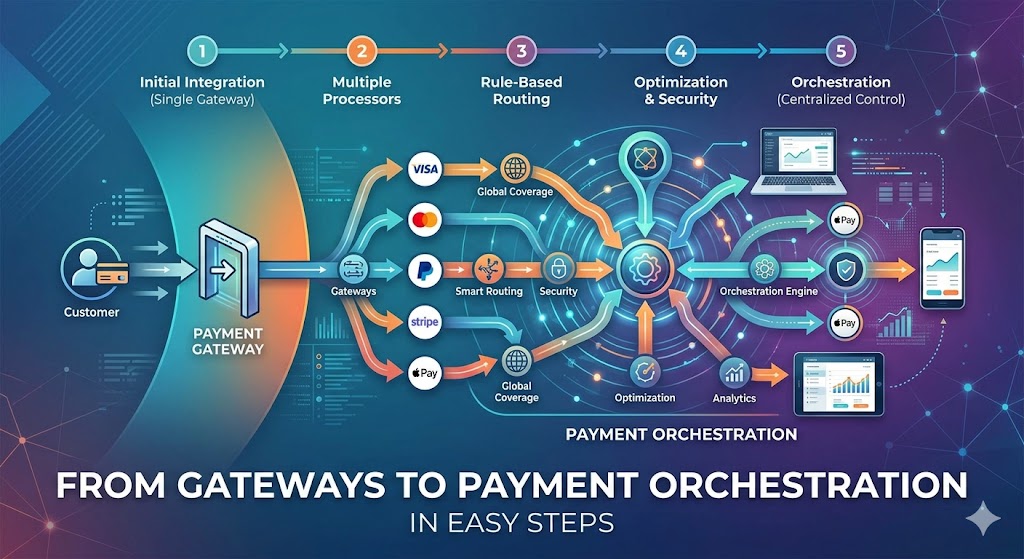
From Gateways to Payment Orchestration in Easy Steps

From Gateways to Payment Orchestration in Easy Steps

Payments have changed. The old way of connecting to a single payment gateway no longer cuts it. Today, businesses need speed, flexibility, and global reach. Therefore, payment orchestration platforms have stepped in — and they are reshaping the entire payments landscape.

In 2025, the global payment orchestration market is projected to exceed $3.5 billion. That growth tells a clear story. Merchants want smarter payment infrastructure. Traditional gateways simply cannot keep up.

What Is a Traditional Payment Gateway?

A payment gateway is a tool that connects a merchant’s checkout to a payment processor. It handles card data, checks for fraud, and passes transactions to the bank. PayPal, Stripe, and Square are well-known examples. However, they each have limits.

Most traditional gateways lock you into one provider. Consequently, if that provider has an outage, your payments stop. Additionally, their routing logic is fixed — they cannot automatically switch to a better path when needed.

For small businesses, this setup works fine. However, as businesses scale, the limitations become painful. High decline rates, single-currency restrictions, and rigid pricing structures hold merchants back.

From Gateways to Payment Orchestration in Easy Steps

What Is a Payment Orchestration Platform?

A payment orchestration platform sits on top of multiple payment service providers (PSPs), gateways, and acquirers. Instead of using one gateway, it connects to many — and intelligently routes each transaction to the best option available.

Think of it like a smart traffic system for your payments. Moreover, it watches each route, picks the fastest and cheapest, and switches automatically when conditions change. The result is higher approval rates, lower costs, and fewer failed transactions.

Leading platforms in this space include Spreedly, Primer, Gr4vy, and Payrails. Each offers smart routing, a single integration point, and real-time analytics. Furthermore, they support dozens of payment methods across multiple regions.

Key Reasons Payment Orchestration Is Winning

First, let’s talk about approval rates. Traditional gateways send each transaction down one path. If that path fails, the transaction declines. Payment orchestration platforms use intelligent retry logic. Therefore, if one gateway declines a payment, the platform automatically tries another — often without the customer even noticing.

Second, consider fees. Different gateways charge different rates for different card types, currencies, and regions. Orchestration platforms route transactions to whichever gateway offers the lowest cost for each specific payment. Consequently, merchants save significantly on processing fees at scale.

Third, look at flexibility. Merchants can add new payment methods — like Buy Now Pay Later, digital wallets, or local payment options — through one platform rather than building individual integrations. This dramatically reduces development time.

How Smart Routing Works

Smart routing is the core feature of payment orchestration. It uses rules and real-time data to decide which gateway handles each transaction. These rules can be based on currency, card type, transaction value, customer location, or historical success rates.

For example, a UK merchant processing a Euro payment from Germany might route it through a European acquirer to avoid cross-border fees. Meanwhile, a high-value transaction might go through a gateway with the best fraud detection for that amount.

Additionally, orchestration platforms offer cascade routing. If the primary gateway declines, the transaction cascades to the next best option automatically. Studies show this approach can recover 5-15% of transactions that would otherwise be lost. That is a significant revenue gain.

Better Data and Analytics

Traditional gateways provide basic reporting. However, payment orchestration platforms deliver deep, real-time analytics across all connected gateways. Merchants can see exactly which gateway performs best for which transaction type.

Furthermore, they can A/B test routing rules to continuously optimise performance. This data-driven approach helps teams make smarter decisions faster. Additionally, consolidated reporting across all PSPs saves hours of manual reconciliation work each month.

Payment orchestration also makes compliance easier. Centralised tokenisation across gateways reduces PCI scope. Moreover, unified fraud management across providers gives merchants a complete view of risk — rather than fragmented data across multiple dashboards.

Global Payments Made Simple

Expanding internationally is one of the biggest payment headaches for merchants. Different countries have different preferred payment methods, currencies, and regulations. Traditional gateways struggle here. Orchestration platforms were built for this challenge.

With a single orchestration platform, a merchant can accept Alipay in China, iDEAL in the Netherlands, UPI in India, and PIX in Brazil — all through one integration. Consequently, global expansion becomes a routing decision rather than a development project.

This is especially valuable for ecommerce brands entering new markets. Instead of spending months integrating local payment providers, they simply activate new connections within the orchestration layer.

The Cost Case for Orchestration

Some businesses hesitate over orchestration platform fees. However, the ROI is usually clear. Consider a business processing $10 million per year. Even a 0.1% improvement in approval rates recovers $10,000 in revenue. A 0.2% reduction in processing fees saves $20,000.

Moreover, reducing failed transactions improves customer experience. Fewer declined cards means fewer abandoned carts and fewer frustrated customers calling support. Therefore, the business case extends well beyond the payment team.

Additionally, reduced development costs matter. One integration replaces many. Engineering teams spend less time maintaining payment connections and more time building product.

Is Payment Orchestration Right for Your Business?

Not every business needs a full orchestration platform right away. However, if you process more than $1 million per year, operate across multiple countries, or experience a decline rate above 5%, it is worth exploring. Furthermore, if you are planning international expansion, starting with orchestration now will save a lot of pain later.

Start by auditing your current payment stack. Look at your decline rates by gateway, by card type, and by region. Additionally, calculate how much you spend on processing fees across all providers. That data will show you exactly where orchestration can help most.

The Future of Payments Is Orchestrated

Traditional payment gateways served their purpose well. However, the demands of modern commerce have outgrown them. In conclusion, payment orchestration platforms offer the intelligence, flexibility, and global reach that today’s merchants need.As payments become more complex, orchestration becomes more essential. Consequently, businesses that adopt these platforms early will process smarter, scale faster, and convert better than those that stick with legacy gateway setups. The shift is already well underway — and it is only accelerating.

Read More:

Why Indian fintechs Lead in API First Tech

UPI Complete Guide: Choosing the Right Payment App

Everything You Need to Know About Payment Gateway Before Launching Your Subscription Box