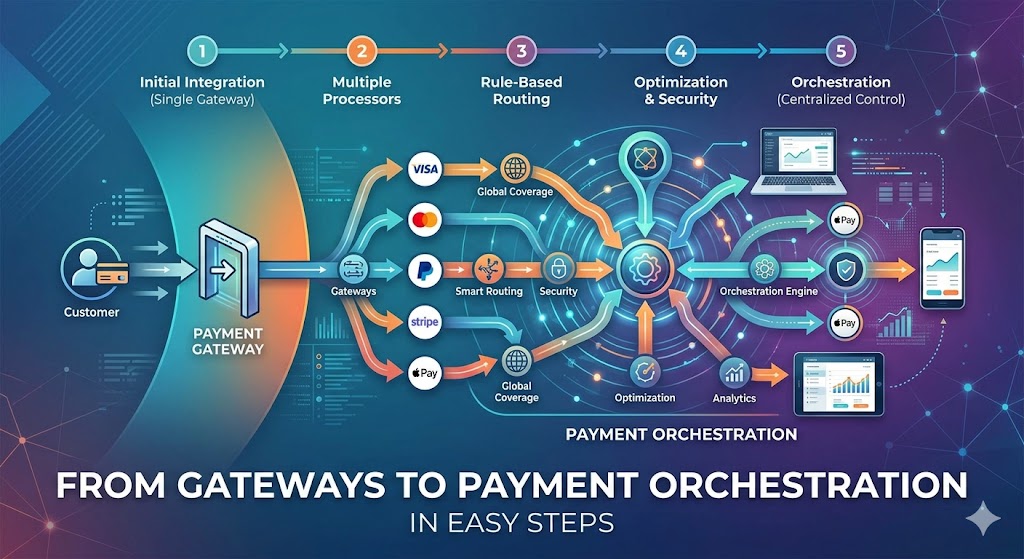
From Gateways to Payment Orchestration in Easy Steps

From Gateways to Payment Orchestration in Easy Steps

Payments have changed. The old way of connecting to a single payment gateway no longer cuts it. Today, businesses need speed, flexibility, and global reach. Therefore, payment orchestration platforms have stepped in — and they are reshaping the entire payments landscape.

In 2025, the global payment orchestration market is projected to exceed $3.5 billion. That growth tells a clear story. Merchants want smarter payment infrastructure. Traditional gateways simply cannot keep up.

What Is a Traditional Payment Gateway?

A payment gateway is a tool that connects a merchant’s checkout to a payment processor. It handles card data, checks for fraud, and passes transactions to the bank. PayPal, Stripe, and Square are well-known examples. However, they each have limits.

Most traditional gateways lock you into one provider. Consequently, if that provider has an outage, your payments stop. Additionally, their routing logic is fixed — they cannot automatically switch to a better path when needed.

For small businesses, this setup works fine. However, as businesses scale, the limitations become painful. High decline rates, single-currency restrictions, and rigid pricing structures hold merchants back.

From Gateways to Payment Orchestration in Easy Steps

What Is a Payment Orchestration Platform?

A payment orchestration platform sits on top of multiple payment service providers (PSPs), gateways, and acquirers. Instead of using one gateway, it connects to many — and intelligently routes each transaction to the best option available.

Think of it like a smart traffic system for your payments. Moreover, it watches each route, picks the fastest and cheapest, and switches automatically when conditions change. The result is higher approval rates, lower costs, and fewer failed transactions.

Leading platforms in this space include Spreedly, Primer, Gr4vy, and Payrails. Each offers smart routing, a single integration point, and real-time analytics. Furthermore, they support dozens of payment methods across multiple regions.

Key Reasons Payment Orchestration Is Winning

First, let’s talk about approval rates. Traditional gateways send each transaction down one path. If that path fails, the transaction declines. Payment orchestration platforms use intelligent retry logic. Therefore, if one gateway declines a payment, the platform automatically tries another — often without the customer even noticing.

Second, consider fees. Different gateways charge different rates for different card types, currencies, and regions. Orchestration platforms route transactions to whichever gateway offers the lowest cost for each specific payment. Consequently, merchants save significantly on processing fees at scale.

Third, look at flexibility. Merchants can add new payment methods — like Buy Now Pay Later, digital wallets, or local payment options — through one platform rather than building individual integrations. This dramatically reduces development time.

How Smart Routing Works

Smart routing is the core feature of payment orchestration. It uses rules and real-time data to decide which gateway handles each transaction. These rules can be based on currency, card type, transaction value, customer location, or historical success rates.

For example, a UK merchant processing a Euro payment from Germany might route it through a European acquirer to avoid cross-border fees. Meanwhile, a high-value transaction might go through a gateway with the best fraud detection for that amount.

Additionally, orchestration platforms offer cascade routing. If the primary gateway declines, the transaction cascades to the next best option automatically. Studies show this approach can recover 5-15% of transactions that would otherwise be lost. That is a significant revenue gain.

Better Data and Analytics

Traditional gateways provide basic reporting. However, payment orchestration platforms deliver deep, real-time analytics across all connected gateways. Merchants can see exactly which gateway performs best for which transaction type.

Furthermore, they can A/B test routing rules to continuously optimise performance. This data-driven approach helps teams make smarter decisions faster. Additionally, consolidated reporting across all PSPs saves hours of manual reconciliation work each month.

Payment orchestration also makes compliance easier. Centralised tokenisation across gateways reduces PCI scope. Moreover, unified fraud management across providers gives merchants a complete view of risk — rather than fragmented data across multiple dashboards.

Global Payments Made Simple

Expanding internationally is one of the biggest payment headaches for merchants. Different countries have different preferred payment methods, currencies, and regulations. Traditional gateways struggle here. Orchestration platforms were built for this challenge.

With a single orchestration platform, a merchant can accept Alipay in China, iDEAL in the Netherlands, UPI in India, and PIX in Brazil — all through one integration. Consequently, global expansion becomes a routing decision rather than a development project.

This is especially valuable for ecommerce brands entering new markets. Instead of spending months integrating local payment providers, they simply activate new connections within the orchestration layer.

The Cost Case for Orchestration

Some businesses hesitate over orchestration platform fees. However, the ROI is usually clear. Consider a business processing $10 million per year. Even a 0.1% improvement in approval rates recovers $10,000 in revenue. A 0.2% reduction in processing fees saves $20,000.

Moreover, reducing failed transactions improves customer experience. Fewer declined cards means fewer abandoned carts and fewer frustrated customers calling support. Therefore, the business case extends well beyond the payment team.

Additionally, reduced development costs matter. One integration replaces many. Engineering teams spend less time maintaining payment connections and more time building product.

Is Payment Orchestration Right for Your Business?

Not every business needs a full orchestration platform right away. However, if you process more than $1 million per year, operate across multiple countries, or experience a decline rate above 5%, it is worth exploring. Furthermore, if you are planning international expansion, starting with orchestration now will save a lot of pain later.

Start by auditing your current payment stack. Look at your decline rates by gateway, by card type, and by region. Additionally, calculate how much you spend on processing fees across all providers. That data will show you exactly where orchestration can help most.

The Future of Payments Is Orchestrated

Traditional payment gateways served their purpose well. However, the demands of modern commerce have outgrown them. In conclusion, payment orchestration platforms offer the intelligence, flexibility, and global reach that today’s merchants need.As payments become more complex, orchestration becomes more essential. Consequently, businesses that adopt these platforms early will process smarter, scale faster, and convert better than those that stick with legacy gateway setups. The shift is already well underway — and it is only accelerating.

Read More:

Why Indian fintechs Lead in API First Tech

UPI Complete Guide: Choosing the Right Payment App

Everything You Need to Know About Payment Gateway Before Launching Your Subscription Box

Data Sovereignty for Payment Providers: A Complete Guide

Data Sovereignty for Payment Providers: A Complete Guide

Data sovereignty is now a major part of the global digital economy. This is especially true for payment providers who deal with complex international rules. Money moves across borders every single day. Therefore, sensitive information must also travel between countries. This creates a clear conflict between global trade and local privacy laws. Many nations now want to control how their citizens’ financial data is stored. As a result, the payment industry must adapt to a patchwork of regional mandates.

Understanding Data Sovereignty in Fintech

Data sovereignty means that digital data must follow the laws of the country where it is located. Consequently, every payment across a border must meet specific residency rules. These rules apply to many different countries at the same time. This is not just about privacy but also about national jurisdiction. If data sits on a server in France, French law governs that data. This remains true even if the company is based in the United States.

Major legal systems like the GDPR in Europe shape this landscape. Also, the CCPA in the United States plays a big role. Many emerging markets now have very strict localization laws too. These laws often say where a company must store and process its data. For example, a payment provider in India might need to use local data centers. This rule applies even if the main office is in another country. Therefore, providers must map out their entire data flow to ensure compliance.

Data Sovereignty for Payment Providers: A Complete Guide

The Operational Impact of Localization Laws

Strict localization laws create many hurdles for payment gateways. A country might mandate that financial data must stay within its own borders. If this happens, the old model of a single global cloud hub starts to fail. Companies can no longer rely on one central database to serve the whole world. Instead, they must build local infrastructure in every major market. This change impacts everything from server maintenance to software updates.

  • Higher Infrastructure Costs: Moving from one central hub to many local servers usually increases costs significantly.
  • Better Latency and Performance: Data that stays local can lead to faster transaction times for users in that region.
  • Less Security Complexity: Managing security across different legal rules requires a very smart and modular approach.
  • Legal Compliance Risks: Failing to store data locally can result in massive fines or even a total ban in some countries.
  • Operational Overhead: Teams must now manage multiple sets of local regulations and audit requirements simultaneously.

Furthermore, payment providers must check their third-party vendors. These include cloud storage and identity services. Every partner must follow these regional rules. Thus, the whole compliance chain must be very strong. If a vendor fails a local audit, the payment provider is often held responsible.


Navigating Cross-Border Compliance Challenges

Payment providers use several key strategies to stay competitive and compliant. First, automation is a vital tool. Manual checks are simply not fast enough for modern digital payments. Automated systems can route data based on the user’s location instantly. This ensures that every transaction hits the right server at the right time.

Moreover, companies are now using “Privacy by Design” methods. This approach builds compliance directly into the software itself. Providers can also use tokenization to protect data. As a result, they can process payments without moving sensitive info across borders. Tokenization replaces a credit card number with a random string of characters. This allows the financial message to travel while the private data stays safe at home.

In addition, transparency is a great way to win over customers. Merchants trust a provider that explains how it stores data. Data breaches happen often in the news today. Therefore, protecting data sovereignty is a great way to build a brand. Clear communication about data residency can be a major selling point in a crowded market.


The Role of Regional Payment Hubs

Many providers are now building regional hubs to balance costs and laws. Instead of a server in every country, they use a hub for a specific legal zone. For instance, a provider might use one hub for the entire European Economic Area. This allows them to follow GDPR while keeping infrastructure costs lower. However, this strategy only works if the countries in that zone have similar laws.

These hubs must be flexible enough to handle sudden legal changes. A country might decide to leave a trade bloc or change its privacy rules. Therefore, the software must be easy to update. Agility is the most important trait for a modern payment gateway. Providers who can pivot quickly will win the most market share.


Future Trends in Global Data Regulations

We expect to see more changes in international data laws soon. Many governments now view data as a national asset. They see it as being just as valuable as oil or minerals. This trend will likely lead to much stricter local audit rules. Governments want to make sure they can see financial data during a crisis.

However, some nations are creating “adequacy agreements” with each other. These deals allow data to move freely between countries with similar security. Payment providers must watch these new alliances closely to grow. If two countries sign a deal, it can lower the cost of doing business there.

The best fintech companies do not see data sovereignty as a legal wall. Instead, they see it as a way to build a safer financial world. By respecting local laws, they build deeper trust with local users. This trust is the foundation of any successful global payment network.


Balancing Innovation and Law

Mastering data sovereignty is no longer optional for payment providers. It is a core part of the business model. Companies must invest in local infrastructure and smart data routing. They must also stay ahead of a changing legal landscape. While these rules are complex, they also offer a chance to innovate. Providers who lead in privacy will lead the market.


Frequently Asked Questions

1 What is the difference between data residency and data sovereignty?

Data residency is about where you store the data. Data sovereignty is about which local laws apply to that data.

2 How does GDPR affect providers outside of Europe?

Any provider that handles data for EU citizens must follow GDPR rules. This is true no matter where the company is located.

3 Why do governments want data localization?

Governments want to protect consumer privacy. Also, they want to make sure local officials can audit financial records easily.

4 Can blockchain technology help with data laws?

Blockchain offers some great solutions. But, it also makes it hard to follow “the right to be forgotten” rules in some countries.

5 What is tokenization for data laws?

Tokenization swaps sensitive data for unique symbols. This allows a company to process a payment without risking the original data.

Read More:

Why scaling like BRICS nations is the new global goal?

AI in Payments: A New Geopolitical Battleground

Will scaling past EU bars unlock your total ROI?