UPI MDR vs Payment Gateway Charges: What Will Actually Cost Your Business Less?
Every business that accepts digital payments faces the same question. Should you rely on UPI, a payment gateway, or both? The answer depends heavily on cost. Many business owners assume UPI is always free. Others assume payment gateways are too expensive to bother with. Neither assumption is fully correct.
This guide breaks down UPI MDR and payment gateway charges in simple terms. We will look at how each works, what they actually cost, and which option fits different business types. By the end, you will know exactly where your money goes with each payment method.
What Is UPI MDR and How Does It Work?
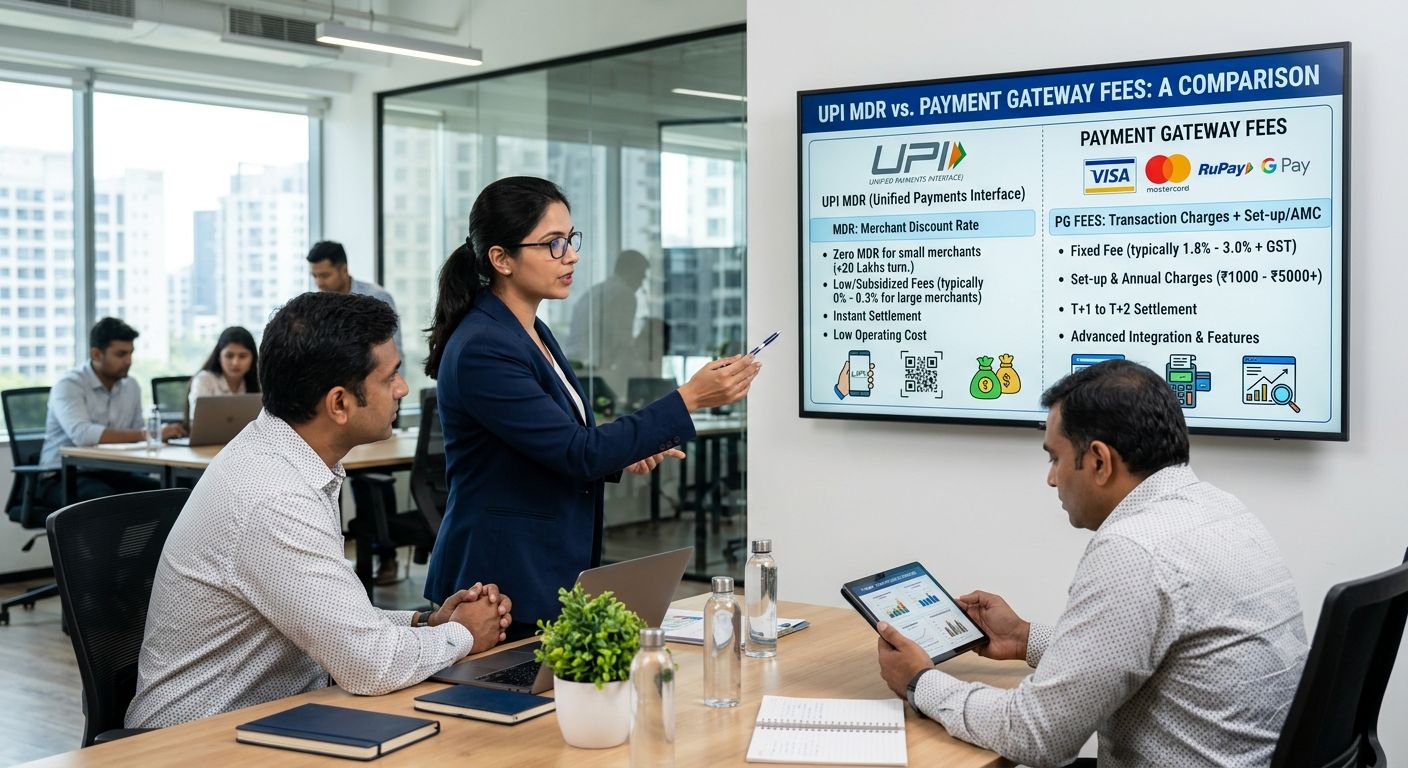
MDR stands for Merchant Discount Rate. It is the fee a merchant pays for accepting a digital payment. For UPI transactions, the Indian government removed MDR on person-to-merchant payments in most cases. This means many small businesses pay zero MDR on UPI transactions today.
However, this rule is not universal. Some UPI transactions above certain thresholds, or made through specific business categories, may still involve charges. Additionally, some payment aggregators add their own service fees even when the base UPI MDR is zero. Therefore, it is important to read your provider’s fee structure closely.
For most small businesses and D2C brands, UPI remains one of the cheapest ways to accept payments. This is especially true for shops, small online stores, and service providers with straightforward transaction volumes. As a result, UPI has become the default payment method for many Indian businesses.
What Are Payment Gateway Charges?
Payment gateways are third-party services that let businesses accept multiple payment types. This includes credit cards, debit cards, net banking, and wallets. Unlike UPI, payment gateways almost always charge a fee. This fee typically ranges from 1.5% to 3% per transaction, depending on the provider and payment method.
Gateway charges often include additional costs too. These can include setup fees, monthly maintenance charges, or fees for international transactions. Consequently, businesses that rely heavily on card payments may see higher overall costs compared to UPI-only setups.
However, payment gateways offer something UPI alone cannot: flexibility. They let customers pay using their preferred method, which can improve conversion rates. For enterprise businesses and online stores with diverse customer bases, this flexibility often justifies the extra cost.
Comparing the Real Costs for Different Business Types in payment gateway
Small businesses and startups with tight margins often benefit most from UPI’s low or zero MDR. If most of your customers already use UPI apps, there is little reason to pay extra gateway fees just for that channel. This keeps more revenue in your business.
In contrast, e-commerce businesses and SaaS companies with larger, more diverse customer bases may need payment gateways regardless of cost. Customers expect multiple payment options at checkout. Losing a sale because a preferred payment method is missing often costs more than the gateway fee itself.
Enterprise businesses typically use both. They accept UPI directly for cost savings on high-volume, low-friction transactions. Meanwhile, they use payment gateways to capture card payments, international customers, and subscription billing. This hybrid approach balances cost control with customer convenience.
It is also worth noting that some payment gateways now include UPI as one of their supported methods. In these cases, transaction costs may vary depending on whether the gateway charges its own fee on top of the UPI transaction. Comparing provider-specific pricing sheets remains essential before committing.
How to Choose the Right Setup for Your Business with right payment gateway
Start by reviewing your customer payment preferences. If most transactions already happen through UPI apps, prioritize direct UPI integration to minimize fees. This works well for local retail, service businesses, and small D2C brands.
Next, evaluate your growth plans. Businesses expecting international customers or subscription models will likely need a payment gateway regardless of UPI’s cost advantage. In this case, focus on comparing gateway providers based on transparent pricing rather than lowest advertised rates.
Finally, calculate your blended cost. Add up your transaction volume across payment types and estimate monthly fees under each setup. This number matters more than any single percentage rate. A gateway with slightly higher fees but better conversion rates might still save you money overall.
Marketing managers and finance teams should collaborate here. Marketing understands customer payment preferences. Finance understands the real cost impact. Together, they can choose a setup that supports both sales and margins.
Common Mistakes Businesses Make by payment gateway
Many businesses focus only on the headline fee percentage. However, hidden costs like settlement delays, chargebacks, and integration fees often matter more over time. Always request a full fee breakdown before signing with any provider.
Another common mistake is ignoring customer experience. A cheaper payment option that frustrates customers can cost more in lost sales than a slightly pricier, smoother checkout process. Balancing cost with usability leads to better long-term results.
Conclusion
UPI MDR and payment gateway charges each serve different business needs. UPI often costs less for straightforward, high-volume domestic transactions. Payment gateways offer flexibility that many growing businesses still need. The smartest approach usually combines both, based on your customer base and transaction patterns. Reviewing your actual costs regularly ensures you keep more of what you earn.

Frequently Asked Questions
1. Is UPI MDR always zero for merchants? For most person-to-merchant UPI transactions, MDR is currently zero, though some categories and aggregator fees may still apply.
2. Do payment gateways always charge more than UPI? Generally yes, since gateways support multiple payment types and typically charge between 1.5% and 3% per transaction.
3. Can a business use both UPI and a payment gateway together? Yes, many businesses combine both to reduce costs on UPI transactions while offering flexibility through gateway-supported methods.
4. What hidden costs should I check before choosing a gateway? Look for setup fees, monthly charges, chargeback fees, and international transaction surcharges beyond the base MDR.
5. Which option is better for a small business? Small businesses with mostly local, UPI-based customers usually save more by prioritizing direct UPI integration first.
Also Read:
How Do You Handle CTO Transitions Without Friction? Ultimate Guide
How Do You Implement AI Dynamic Pricing Today? Ultimate Guide