online payment

What is Online Payment Processing?


From an earlier time, even before the invention of money, people exchanged goods and services in return for some mode of payment. Mode of payments was not financial as money didn’t even exist at that time instead they followed the barter system and livestock exchange. With the evolution of technology payment systems have changed drastically making financial transactions possible at any time and from anywhere.


What is Online Processing?

We are now in the Online Payment Processing era let’s dive deeper into it and know what exactly online processing is. Any transaction done electronically is known as an online transaction. It can be through a mobile device, a computer, or a POS machine. It requires firstly an internet connection then a secure ecosystem and encrypted information or your credentials.

The most debated topic today is the war between online and offline payments, wherein online payments seem to be winning by far, here’s why,

  • Online payment is quick and easy, a huge amount can be transferred in seconds.
  • Ease of managing the payment records thus reducing online fraud.
  • Payment gateway integrators like Digital Payment Guru make the entire payment process hassle-free with easy payment gateway integration into your existing system thus increasing your success rate.
  • International transactions can be done from one place and without facing different currency problems.
  • Payment can be sent and accepted 24*7 without any interventions.
  • An online business can offer multiple payment options to its customers so that customers can make payments with the desired payment method. This can help online business to retain their customers.

Is Online Payment Processing A Necessity?

Earlier, the Organization used paper checks for making payments. Maybe because it was the only mode of payment available and also it saved on the cost. After the introduction of FinTech companies, these organizations have started using online payment modes as a primary way of payment as it saves time and also reduces the hassle of managing the paperwork. It also eliminates the risk of fraud as all the payment records are easy to maintain.

A recent study states that 81% of organizations prefer online payment compared to offline payment modes because of its advantages and thus it can be concluded that online payments are no more a choice but a necessity. So, if you want to improve your business and retain your customers, it is important that you provide what your customers want. Thus, switching to an online business can benefit your business.


The need for Online Processing for your Business

Are you new to the online business or you have just developed an e-commerce website? Apart from design and smooth interface, you will need a secure and trusted payment gateway. Now that you know what online processing is, it is time for you to choose a payment gateway for your business. Before getting a payment gateway for your business let’s discuss its need for your business.

  • Secured Payment Gateway: The payment gateway is highly secure and the customer’s details are encrypted eliminating the risk of fraud.
  • 24/7 Support: Customers can make a payment anytime and from anywhere for your goods and services.
  • Shopping Cart: Payment Gateway provides your customer with a shopping cart feature for a better payment experience.
  • Payment Tracking: The payment gateway provides tracking of payments for past and present transactions, maintaining the record in one place.
  • Multiple Payment Modes: Customers can make payment through the desired payment mode thus providing ease of payment for the customer.
  • Platform Independent: Payment can be made from different devices like computers, mobile, tablets, etc.
  • Faster Processing: Online payments are quicker and more convenient than offline payment as it avoids the hassle of waiting in the queue for making payments.

Every payment gateway has its features and plugins thus it is necessary to analyze your business needs and choose the right payment gateway that is suitable for your business.

Digital Payment Guru can help you choose the best payment gateway for your business by analyzing your business needs. We provide top payment gateways like PayPal, PayU, Paytm, Instamojo, and Atom at the best market rates. Visit our website and get started.
 

UPI-_2_

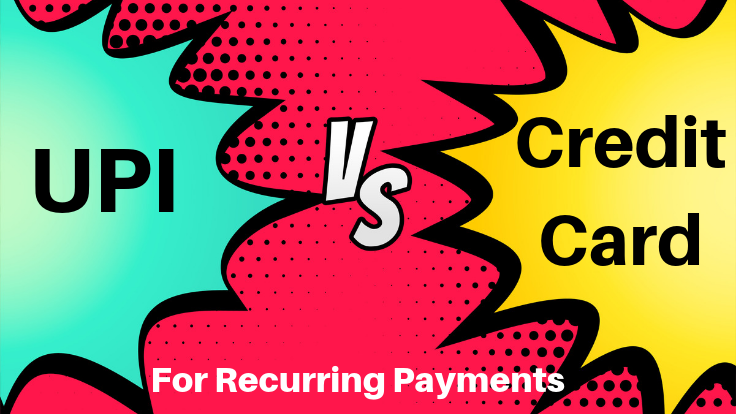
Recurring Payment Via UPI Or Credit Cards?


Does your business require a collection of online payments for products and services at regular intervals?
Payment gateway providers make it easier for customers with Credit card options. With UPI coming into a lead, it would be a great contender. Which one should you go for recurring payments? Let us find out.

What are Recurring Payments?

In a recurring payment model, the service providers deduct the purchase amount from the buyer’s account at regular intervals which are set up automatically.
There are multiple recurring payment businesses, some use an invoice method wherein a payment is automatically deducted against an invoice and others use a Subscription Model business wherein you only pay as you use the services or product.

How does Recurring Payment Work?

To enable recurring payment, a customer must save the card and grant permission for the recurring charge. Stored payment data can then be used used to automatically process payments for repeat services or subscription model business. Payment gateway service providers can automate all types of business billing needs. Some have payments based on invoice cycle others initiate and manage recurring payments. Solutions are different for both types and thus it is necessary to identify your billing needs before getting a recurring service.

What is UPI?

Unified Payment Interface (UPI) is a single platform that provides different banking services and features. If your bank is UPI enabled, you can create a UPI ID that can be used for making transactions. A transaction can be made using an Aadhaar number, Mobile Number, and Virtual Payment Address (UPI ID). UPI allows the user to transfer and receive money from one bank account to another by using a smartphone. It enables the transfer directly from a bank account to the merchant and also handles basic banking activities. UPI is a revolution that can be an alternative to e-wallets, in other words, UPI is the best thing in the online money market.
According to NPCI, in March Rs.1.33 Lakh Crore of transactions is made via UPI which is a 24% increase from February 2019.
In 2018, UPI launched its second advanced version UPI 2.0 with more features but NPCI did not add recurring payments to support in it. This feature could be coming in UPI 3.0.
The feature can enable customers to issue a one-time mandate for recurring payments for services from the merchants. The best example can be automatic payments of monthly bills and subscription-based services. RBI refuses to release these features for UPI for fear of its misuse.

UPI vs Credit Card for recurring payments?


Business prefers to set up recurring payments against Credit/debit cards. Some global businesses like iTunes set it up on debit cards with One-factor-Authorization.

Unified Payment Interface:

  • Recurring payment support for UPI is coming soon.
  • A customer has full control over authorization for the requested payment.
  • In the case of refunds, the merchant and buyer communicate directly.
  • UPI is will be available with the banks that do not provide recurring payments.
  • A recurring payment can be availed by anyone that has UPI.

Credit Card:

  • Recurring payments are available on credit cards.
  • Money is debited Automatically without the customer’s involvement.
  • In the case of refunds merchant also has to deal with the customer’s bank.
  • Recurring payments can be availed by those having a Credit card.
  • A recurring payment cannot be availed with banks that do not allow it on a card.


What Is A High-Risk Business?


Some Online Businesses and industries are treated as high-risk businesses by payment processing companies. They are categorized as high-risk businesses depending on several factors such as the chargeback ratio of a merchant, times the product is returned, or payment processing history. Considering these factors, payment processing generally does not prefer to provide its services to high-risk clients.

High-Risk Factors:

Merchant account providers and Payment Processors consider a business as high risk if it has a higher chargeback ratio, The customer makes a credit card payment and cancels it when the merchant has received the payment, Refunds for the returned products, and credit card fraud. Companies having a bad credit history and those which provide no guarantee for loans are also considered high risk.

What is High-Risk Payment Processing?


Any business wanting to start an online payment first needs to have a merchant account. A merchant account has 2 types, low-risk merchant account, and high-risk merchant account. If you run a low-risk business which means your business is not involved in any of the above mentioned factors then you can easily approach the payment gateway service providers and they will easily offer their services. But, it is not the same with high-risk businesses. The high-risk business has all the factors mentioned above because of which such businesses find it difficult to get paid service providers as they do not want to serve such businesses.

The business that is categorized as high risk has a higher possibility of an increase in a chargeback. This also leads to higher payment processing fees which relate to risks involved with such businesses.

High-Risk businesses pay high chargeback fees, payment processors put a reserve on merchant accounts which can be used by acquiring banks to compensate for the chargebacks. With this practice, an additional layer of protection is on offer on the bank’s side against any unexpected behavior from the merchant.

If you run a High-risk business the best solution is to maintain a good relationship with payment gateway providers that specialize in such businesses. These payment gateway providers can help you monitor suspicious transactions.

Types of business considered High Risk:

When you apply for a merchant account, you go through an underwriting process with a payment processor. Different processors have different standards, so even if there are some similarities in your business but the following things that can put your business in a high-risk category.

  • Bad Business or Personal Credit Score: Bad credit score is a negative impression for payment processors as it is considered that you are not good at managing your finance or are more susceptible to fraud.
  • Merchant Account History: This shows your record stating a history of chargebacks or frauds with another merchant account provider, if there are any it will create a negative impact on your application.
  • Years in business: The older business you have the better impression you have on the merchant account provider. Merchant account providers are more careful with customers having less experience in the business.
  • Headquarters Location: If you provide service to another country where your headquarters isn’t then you are more prone to fraud.
  • Questionable Products: This completely varies for different payment gateways, but the best example is gambling, as it is illegal in some countries.
  • Huge purchase amount: If you have an unusually high average purchase amount, there are more chances of fraud because of which it can be considered as a high-risk business.

It might seem a bit unfair for High-risk businesses as the payment processing is expensive for such businesses. Many payment processors will not want t work with you but also there are many reputed service providers that can take your business. Do some research, evaluate your ideas, and be careful with the term before signing.


How to start an online business?

Many people want to start selling their products online but, there are many questions that run into their minds:

  1. How to get started?

Well, initially you should analyze your position in the market and how you are different compared to others. To do so there are various factors, some of them are:

  • Price
  • Marketing
  • Features
  • Technology

The moment you get to know where you stand in the market, the next step is to convey your products to people. You can do this by talking with people about your products, by creating your website or by creating a portfolio of your business and sharing it on social media so that your business reaches to maximum people. This should be your first step as it is the most effective.

Related Post: How is payment gateway beneficial for B2B Companies?

  1. How to increase your products reach?

Not all people are active on social media or are familiar with social media but want to increase their business reach. Thus, it is important to analyze what people want, also, if your product has some features that others don’t then stress on that particular feature more than others. The most efficient way of getting started is:

  • Ask the people who have used your products to share their experience. It is always a better way of promoting your business from your user’s experience than by yourself alone.
  • Create your business page on social media and invite your friends to like your page. Post regarding your products on your page and ask your friends to share those posts.
  • Create content for your product, this content can be shared on relevant business websites where people usually search for the products that you are offering. This will also give a backlink to your business which can help in boosting your business up.
  • Write effective blogs with your success story, share such blogs on blog sharing sites like a medium where people always look up for motivating blogs. Also, share your blog on social media so that it reaches more people and they can share your story with others.
  • Run Facebook ads and Google ads for your products, Digital Marketing is the best way to increase your business reach. Also, it is a cost-effective and easy approach.Digital Marketing
  • Finally, references are the best way to boost your business. You can get as many leads and customers from your campaigns but there are only a handful of customers that give you an effective business. Always take feedback from such customers because they will definitely refer their friends which makes a lot of difference from getting leads through campaigns. Remember, Client Acquiring is done at the start of the business but Customer retention is much important for the growth of the business.

Related Post: Digital Payments for successful E-Commerce Business.

  1. How to remain competitive in the Market?

Once you have achieved your position in the market, now it is important to maintain your position and not letting it harmed by competitors. To do so, always have a good team to handle different aspects of your business rather than you handling everything alone. Get a payment gateway integrated into your website to make your website payment-enabled so that people can make payment for your products from the website. Make sure the payment gateway provides multiple payment options providing convenience for your customers to make the payment from the mode they are comfortable with. Ensure that your team brings something innovative to the desk so that more customers are attracted to your products.


Everything you need to know about a Payment Gateway_png

Everything you need to know about a Payment Gateway.

If you start an online business and want to accept payments online, a payment gateway is something that you will need. They might sound a bit out of your box by now, just continue reading I assure it is not that complex as it sounds. Here’s a brief about what payment gateway is, how it works and how can you get started with a payment gateway for your business.
What is a Payment Gateway?
The payment gateway is a service that is responsible for the authorization of your card details and then transfers the details to the payment processors. You receive a confirmation for your transaction which is again handled by a payment gateway. Sounds tough? Well in simple words, Payment Gateway act as a bridge between the transaction that the customer wants to make and the payment processor. Your website or mobile application cannot directly connect with the bank for security reasons thus a payment gateway is required. Thus, Payment gateway is the mode of sales by which you can charge your customers who want to buy your products online.
What is the role of the Payment Gateway?
Payment Gateway service is the same as the POS machine where you can swipe a card to make an online payment, in Payment Gateway service customer enters their card details online to make a payment for your products.
The main role of the payment gateway is to authorize the transaction you and your customers. Without a payment gateway approving the transaction you will not receive your money.
Do you need to have a Payment Gateway?

online payment
It completely depends on your business requirements, it is very important to analyze your business requirement before integrating a payment gateway. If you run an e-commerce website and want to start accepting payments online then you definitely need a payment gateway service as there is no other way to accept any kind of online payment without having a payment gateway.
Make a note that the transaction processed by a payment gateway is a card, not present transactions which means that the merchant relies on the credit card information that is provided by the customer.
While making a card-not-present transaction, the data is not run on the EMV chip in the card unlike POS machine transactions so, the risk of fraud increases. Thus, these transactions can charge you higher than a card-present transaction.

Related Post: How to does a Payment Gateway charge?

How does a Payment Gateway work?
From a customer’s view, the payment gateway is quite straightforward where the customer visits your website, adds products to the cart and then checks out making the payment for desired products via a payment gateway by adding the card details.
But it is a bit more complex behind the scenes.
The gateway processes in the following steps:
1. The customer enters the card details and makes payment for the desired products on your website. This transaction is a card-not-present transaction for which the charges are quite high for security. This information is encrypted and sent on its way.
2. The encrypted data is sent to the payment processor which the company that processes the payments.
3. The payment processor sends the data to credit card associations like Visa or Master card. These associations charge an interchange fee for each transaction.
4. Now the transaction is either approved or declined for which the card firstly needs to be valid and have enough funds.
5. Once the transaction is authorized the issuing bank transmits the data to the payment processing parties.
6. The execution of all the above steps takes just a second but it might take a couple of hours for the amount to be reflected in your account.

Related Post: How to integrate a Payment Gateway?

How to choose the right payment gateway for your website?
There are different ways of payment gateway integration,
Hosted Gateway: Hosted method is a third party integration method and the customers required to leave the current page and are directed to the payment page to complete the transaction.
The drawback of this gateway is that it might lower your conversion rate as it directs the customer to another page to complete the transaction. Thus, customers will not trust such a payment gateway.
Non-Hosted method: This payment gateway allows the customer to make a transaction without having to leave the current page and the integration of these payment gateways can be done through API.
The drawback is the maintenance of the payment gateway infrastructure also, before integration of this payment gateway you need to be PCI DSS compliance as all the client details are stored on your server.
Now, you are aware of the differences in payment gateway integration you can choose your payment gateway by analyzing your business requirements as different payment gateway have different features like auto-fill OTP and more. Also, the payment gateway fees, multiple payment modes, multi-currency support, PCI-DSS compliance, fraud prevention are some of the points to be considered before integrating a payment gateway.
Still, if you are confused as to which payment gateway to choose from, visit Digital Payment Guru to find the top payment gateways at best market rates. Digital Payment Guru also helps you find the best payment gateway for your business by analyzing your business requirements.

What makes E-Commerce Payments Secure?


The e-commerce market in India is so popular these days that everyone buying products on e-commerce websites is very much aware of what a payment gateway is. An E-commerce payment gateway is basically the platform that handles the transaction from the user to an e-commerce website. Payment Gateways provides multiple payment modes for customers so that they can make payments through a mode that is convenient for them like credit/debit card, Net Banking, UPI, and more.  Because of the increased purchase using a payment gateway, it becomes mandatory for the payment gateways to be to carry out certain security measures. Without a secure payment gateway, E-Commerce cannot sell their products online and the customer cannot proceed to the payment gateway to make the purchase.

Fraud Concern: To date, people still find it more trustworthy to buy products from a local shop than buying them from an e-commerce website. The chances of becoming a victim of fraud are very much less compared to that of buying online. The common fear that customers have with online shopping is, paying for the product online and not receiving it or risking personal card details to an e-commerce site.

To avoid all such fraudulent activities, an e-commerce business spends a huge sum to maintain a secure payment system for the customers to make a transaction for purchasing products.

Following are some security practices adopted by the payment gateway providers:

  • Data Encryption: Data encryption is an essential security measure. When you enter your data, it is encrypted with a public key that can only be decrypted with the payment gateway’s private key. If this sounds tough to understand, refer to this example: When you are buying a product from an e-commerce website when you are directed to a payment page and you add your details for making the payment, your details are saved with the website to speed up the payment process for next time, but only you can view your details and no one else. This is called encryption. Also, the payment gateway providers will not be able to see your details in the backend as it appears decipherable to them, this is known as decryption. Even in an attempt of hacking they still will appear decipherable to the hacker thus securing your credentials.
  • Security Socket Layer (SSL): When it comes to online business, an essential component is a secure payment gateway that creates a trustworthy environment for your potential customers. SSL builds up trust by achieving a secure connection. SSL is a standard security technology that helps in achieving an encryption link between a server and a client. In simple terms, you enter your information on the browser and the information is taken to the server, this is done by SSL. SSL is also used to authenticate the visitor that visits a website and also protect sensitive information like the card details of your customers. All the major e-commerce websites use SSL making them secure for customers to make an online purchases. The same cannot be guaranteed for websites without SSL. So it is not recommended to make online payments from such websites to avoid any online fraud. Websites with SSL can be easily identified, check for ‘https’ before the website address.
  • Tokenization: Tokenization is the process of replacing sensitive information like card details or passwords with non-sensitive information also known as a token. A token is an identity that maps sensitive data through a tokenization system. For example, sensitive data can be replaced with random numbers. When a token replaces live data in the system it prevents sensitive data to be accessed by unauthorized users thus reducing the risk of accidental exposure. The sensitive information like Credit/Debit card details is replaced by a token. It secures the details of customers in the server and provider them with a unique token that can be used for one-click payment when they revisit the website for purchasing any product.

All of these are the security measure that payment gateways have adopted to ensure safe online transactions. If you are looking for payment gateway solutions for your e-commerce website visit Digital Payment Guru for top payment gateways at the best market rates.

To know what is PCI DSS compliance click here.


payment gateway

How to Reduce Online Shipping Costs for Small-Scale Businesses?

Basically, charges for shipping/delivery that a includes on its bill are taxable only if the product that is being shipped/delivered is taxable. The terms shipping/delivery also include charges identified by terms such as transportation, handling, or postage.

Shipping is the most cost-consuming expense, especially for small-scale businesses. It is very challenging to reduce shipping charges if your business sells physical products. Over 30% of customers cancel or abandon their cart after looking after the shipping prices they have to pay for the products they ordered. Customer satisfaction should be the first priority for any business brand. Surpassing customer expectations and satisfaction with services or products supplied always leads to gains and profits for the company. Therefore keeping customers engaged during the checkout process is through having a good grip over the shipping process.

Shipping tax or costs not only include the amount associated with shipping but also the cost required for the supplies during the transportation of products. So how small-scale businesses or startups can reduce shipping costs without any losses but can also attract and satisfy their customers?

Here are some ways to Reduce Online Shipping Costs for Small Scale Businesses :

Use a shipping calculator:


A shipping calculator is a software solution built for the purpose of making shipping rates and service details available for online users in a meaningful way. It is not too common in small-scale businesses as they shift the decision of calculating shipping costs to your customers. Many people have a misconception about losing money in this but it is nothing to worry about as no money is lost. On the bright side, many businesses have started using shipping calculators to promote transparency and clarity with their businesses. This helps customers to understand clearly why they are being charged a particular amount as the delivery cost. While assessing the cost variation of the delivery area from the warehouse shipping calculator is useful.

Standard postal services:

For small-scale businesses who are starting out recently with small quantities, it is best advised to use standard postal services for shipping. The primary function of the Post Office is the collection, processing, transmission, and delivery of mail. All postal articles whose contents are in the nature of the message can be classified as mail which includes Letters, Postcards, Inland Letter Cards, Packets, Ordinary, Registered, Insured, Value Payable articles, and Speed Post. It is a government service, the cost is low and one can also control their logistics working.

Prepaid shipping:

Sometimes, when the shipments are prepaid, shipping providers provide discounts and lower costs. This way a company can buy labels and stamps in bulk amounts and fix them for packaging even before they are ordered. This way time is consumed and the company works in an organized manner without any difficulties while shipping.

Introduce Flat rate shipping:

Flat rate shipping includes a lot of indirect values of cutting down the delivery charges. Basically, it means having a standard amount of charge no matter what the size of the product or package is, small, big, or medium. This attracts customers more and gives them a chance to order as many as products they want in the maximum amount, they are going to get charged the same. Not only that but flat-rate shipping helps promote your business’s order size.

Recycle your packaging:

This will be the perfect time to use your Eco-friendly card. Using Eco-friendly packaging material not only saves your money but also nature. The smart way to reduce shipping costs is by reusing packaging material from the returned products.  Bubble wraps, shreds, and polystyrene can be recycled and used again for packages. As a bonus, this reduces your garbage and helps the environment.

Get familiar with your online shipping reps

Representatives of major shipping carriers negotiate rates and help businesses understand the entire shipping process. These agents play an integral role in completing the shipping process. It will prove beneficial for you if you search for the right representative for your business who will get discounts and the best rates. Stay in touch with these representatives to be updated about the different rates, revised pricing, and shipping rules.


payment gateway

How To Integrate a Payment Gateway?


If you are running an e-commerce platform or just having an online presence, you need to have something using which your customers can make a payment online. To enable a seamless and convenient payment option that is also secure at the same time, a payment gateway is something that you will definitely need to enable your website to accept payments online. While choosing a payment gateway you have to check if the payment gateway supports all your business requirements. It has to be compatible with your existing platform, it should provide multiple payment options, and mainly it should be protected from fraud.

To know how to integrate a payment gateway into your E-Commerce site click here

What is a Payment gateway?

Well, payment gateway services are the only way in which you can accept payments through a website or mobile application. They act as a bridge between the transaction that the customer wants to make and the payment processor. The app cannot directly connect to payment processors for security reasons thus payment gateways are required.

The payment gateway can handle the following types of transactions:

Authorization:

It is the type of transaction wherein it is checked whether the user has enough amount in his bank account to make the payment for the desired product or service. If he has the amount then the order is placed. Such a type of transaction is used for orders that take time to ship.

Capture:

Capture is the actual processing of the funds to the merchant’s account after the authorization transaction.

Sale:

Sale transactions are a combination of Authorization and Capture transactions wherein the user’s card details are first authorized to check if there are enough funds in the user’s account to make payment for the product. After authorization, the funds may or may not get captured. It is used for immediate purchases like subscriptions and e-tickets.

Refunds:

The mode of transaction in which an order is canceled and the merchant has to process the refund to the user.

Void:

It is similar to a refund but can be initiated only when the funds are not captured.

How to integrate a payment gateway?


There are several methods for the integration of a payment gateway into your website.

  • Hosted Gateway: Hosted method is a third-party integration method and the customers require to leave the current web page and are directed to the payment page to complete the payment. Here the payment processing is taken care of by a service provider, also the card details of the client are saved by the vendor thus this method does not require PCI DSS and provides easy integration. Also, the drawback of such a payment gateway is that the customers may not trust the third-party payment system, and directing them to a different page will lower your conversion rate creating a negative impact on your brand. Such a payment gateway is suitable for small to medium businesses.

How to integrate: The guidelines are available on the vendor’s website. A javascript code is available on their website which needs to be integrated into your website, after integration it places a button on your website by clicking on which it activates vendor API to manage the transaction.

  • Non-Hosted Method: Non-Hosted methods allow customers to make payments without having to leave the current page. This method allows the integration of payment gateway through APIs. The benefits of having an integrated payment gateway are that you have full control over the transaction unlike hosted integration method and also provides easy customization of the payment gateway to compliment your website. The drawback is the maintenance of the payment gateway infrastructure, also before integration of a non-hosted payment gateway you need to be PCI compliant as all the clients’ card details will be stored on your own server and it becomes quite tricky if you opt for any customization. This payment gateway is suitable for medium to high business that relies on branding and user experience.

How to integrate: Non-Hosted payment gateway integration is done via API into your website. Also, a technical team is required for the integration of the payment gateway. Most non-hosted payment gateway providers have a well-documented guide readily available.

  • Direct Post Method: Direct post method allows the customers to make the payment without leaving the current web page. Also, you do not need to obtain PCI compliance. It assumes that the details of the transaction are directly sent to the payment gateway after the customer clicks on the payment button. The data is transferred to the gateway and processor without being saved on your own server. The benefits of direct post methods are similar to that of non-hosted payment gateway like the customization option but without having to be PCI compliant and the user makes payments without getting directed to any other page. The drawback is that is it not completely secure. These payment gateways are suitable for all types of businesses.

How to Integrate: The payment gateway service providers may set a connection between the payment gateway and shopping cart to transfer the user’s credentials.


Online Payment Fraud in India – How is the Youth Affected


Online Payment have taken the market by storm. The positives of digital payment have compelled most businesses to add this method as a mode of payment. Doesn’t everything sound too good to be true? Well, digital payments have downsides to it too, and with more and more people becoming aware of the risks of data breaches, banks, and payment gateways are finding better ways to secure customer data.


Studies suggest that there is a strong correlation between the rise in the adoption of mobile applications, and online payments and an increase in financial fraud. As per a global survey conducted by FIS in 2019, statistics state that Indians are amongst the most frequent victims of online banking frauds so much so that the rate has doubled to 37% this year against 18% last year.

The rapid pace of digitization has created a competitive situation in the market wherein banks and payment wallets have developed apps for customers along with websites to complete quick and hassle-free transactions. Yet, around 96% of people who chose mobile apps over traditional modes of payment were affected by online payment fraud.
As per the data released by RBI for the financial year 2017-18, banks lost around Rs 32,000 crores of public money to online payment fraud. This showed a three-fold rise in digital scams in the last 5 years.


Let’s dive a little deeper into the different types of payment fraud and what steps have been taken by financial institutes to curb the repetition of such cases.


What are the common types of online payment fraud?

Online payment
Even after banks repeatedly send out notices and warnings about the types of payment frauds and how to be wary of them, hackers find a way to pose as authorized personnel to commit the crime. The most common types of payment fraud in India are:

Phishing:

Phishing is the process of accessing the target’s personal information and financial credentials through e-mails, text messages, or over calls. This sensitive information obtained by hackers is then used by them to their benefit.
Friendly Fraud:

Also known as a Chargeback Fraud, Friendly Fraud is when a customer (fraudster) completes the payment process with his own credit card. On receiving the goods or service, he then requests the issuing bank for a chargeback stating that his card was lost.
Unsafe apps and websites:

While casually browsing on the internet, we come across a number of pop-ups and are rerouted to unknown websites or app links that turn out to be fraudulent. People who are unaware of the pitfalls of such scenarios tend to give away sensitive information that is later misused against them.

Why is there a rise in online payment fraud in India?

After businesses bore the blow of demonetization, close to 1/3rd of India’s population resorted to online payment systems. It then became fairly easy for hackers to obtain confidential data. Some of the reason why there was a hike in the rate of fraud is:


• Lack of prosecution for such crimes.
• Low priority of digital payment frauds.
• Frequent calls from people pretending to be from banks and asking you for your personal details.
• Difficulty in nabbing the fraudster due to fake accounts created by him.

To know what is online fraud and how to prevent it click here.


Who is affected the most by online payment fraud?

A number of factors drove the younger generation to move to online modes of payment from their traditional counterparts. Low cost of mobile data connectivity, user-friendly interface of apps and websites, and convenience on-the-go form the top three tiers that contribute to the growth of digital payments. The age group of 18-37 is the prime audience that is affected by such online frauds as they are the working class and it is convenient for them to make transactions while traveling because of their busy schedules.


How are payment gateways securing customer data and preventing online fraud?

Since a large chunk of people is opting for payment gateway integrations, it goes without saying that data security becomes a major concern. Many steps are taken by such gateways to ensure the customer’s information is safe and secure. Some of the basic but important methods of securing data are:


• SSL Protocol
PCI DSS Compliance
• Tokenization
Encryption of data

Such steps create a sense of security in the minds of the customers so they complete transactions without giving it a second thought.

We, at Digital Payment Guru, partner with payment gateways that are leading in the market. We understand your concern about online payment fraud and ensure all transactions are secured under PCI DSS Level 1 compliant technology and fraud scrub. This allows customers to go ahead and make payments without worrying about the threats of data leaks. Head on to Digital Payment Guru to know more!


payment gateway

How Is The Payment Gateway Beneficial For B2B Companies?


Payment gateway became necessary for B2B companies with the rise of digital payments. B2B companies are switching to digital payments to simplify their daily business operations. B2b companies have a greater liking for digital payments over traditional payments.

There are still several companies that prefer traditional methods through checks and cash, whereas digital payment methods have made online payments easy with various payment modes like UPI, Netbanking, and Credit/Debit cards.

How did B2B company’s transaction work?

Well, a transaction is called B2B when one of the businesses acts as a customer to another business, the transaction can involve services like development, email tools, and more, or can involve parts and units. With the growing business, managing payments of vendors and suppliers through cash and check becomes a difficult task.

Why should B2B companies have a payment gateway?

During the purchase of supplies and services businesses usually, prefer to make bulk payments. They look out for multiple payment modes and want to be sure their payment is secure. They want to have track of these payments and also they want to trust their business partners.

Well, all of the above mentioned things are not possible with traditional payments, in fact, there are more cons in traditional payment methods as the check gets bounced, cash is difficult during bulk transactions. Thus, having a payment gateway simplifies these problems by providing complete transactions and providing multiple payment modes which can increase customer footfall for the B2B industry.


Benefits of B2B companies having a payment gateway.

In business, your Time is Money and the payment gateway handles both these entities. The ease of payments with lesser errors enables B2B companies to accelerate their transactions from vendors to suppliers. Following are the benefits of having a payment gateway.

  1. Saves Time and Effort by providing a payment button by clicking on which payments can be made thus eliminating the efforts of handling paper checks.
  2. Guarantees the payment from the buyer to the seller.
  3. Trackable goods and services and payment notifications.
  4. All online payments are secure giving the seller confidence to do business with new parties.
  5. Faster payment collection with guaranteed to reach clients at a specific period.
  6. Hassle-free payments by eliminating the security risks associated with cash payment.

Why Switch to Digital Payments from Traditional Payments?

In traditional payments dealing with cash and checks can get tedious at times, also drawback is physically mailing the invoices to the clients which consumes a lot of time and effort. Payment gateways eliminate this process by providing payment automation wherein your clients get a notification for payments they make thus avoiding the hassle of managing cash, and checks and physically sending emails.

Related Post: Digital Payment Gateway for Successful E-Commerce Business

How do B2B companies use payment gateways?

online payment

Integrate a payment gateway into the website:

Many companies integrate a payment gateway on their website allowing the customers to make a purchase from the website. This also allows them to choose from various modes of payment like credit/debit cards, net banking, and UPI. Most business also provides NEFT.

Add bank details on the website or email bank details:

Many companies provide bank details on their website or in the pricing section which is added to the account to transfer the amount. Some companies email their client bank details to receive payments.

Payment Links:

This is the easiest way of collecting payments, B2B companies share the payment link on social media platforms like Facebook, Whatsapp, and SMS. Customers can click on this link and make payments. Payment also offers customers to use multiple payment modes to make payment.

Recurring Payment:

B2B companies provide recurring payment set up for their client so they do not need to worry about paying at regular intervals. Recurring payments are basically instructions sent to the bank to debit the amount at a certain date.

How Digital Payment Guru facilitates B2B companies?

Digital Payment Guru provides top payment gateways like PayPal, PayU, Instamojo, Atom, and Paytm at the best prices compared to market rates. We help you choose the best payment gateway according to your business by analyzing your business needs.