How Do You Price Products Under UPI MDR Changes

How Do You Price Products Under UPI MDR Changes? Ultimate Guide

How Should Businesses Reprice Their Products After UPI MDR Changes?

For years, UPI payments cost merchants nothing. The UPI MDR changes will alter that. From 15 October 2026, a new merchant discount rate, or MDR, applies to some UPI payments. Many owners now ask a fair question. Should we raise prices, absorb the fee, or find a smarter path? This guide answers that question in plain words.

The rules are new, so details may shift. Check your bank or payment provider for the latest terms. Talk to your chartered accountant before you change any price. The steps below are general guidance, not financial advice. They give you a clear starting point for your own numbers.

What the UPI MDR Changes Mean for Your Business

MDR is a fee that a merchant pays to process a digital payment. It is usually collected by banks and payment providers. Under the new framework, a 0.4% MDR applies to eligible person-to-merchant UPI payments above Rs 2,000. Reports say the fee is capped at Rs 300 per transaction. Payments up to Rs 2,000 remain free, and so do person-to-person transfers.

Some sectors get a flat, lower charge. Reports list railways, telecom, insurance, fuel, and farm inputs in this group. The flat fee in those cases is Rs 5. Small merchants are said to stay exempt. Furthermore, customers do not pay the fee. The merchant does.

Here is a simple example. A customer pays Rs 3,000 for an order. The fee at 0.4% is Rs 12. You receive Rs 2,988 in your account. For a single sale, that sounds small. However, the total adds up when you sell hundreds of orders each month.

Meanwhile, cards already carry a fee for merchants. UPI at 0.4% is lighter than most card costs. Therefore, shifting customers away from UPI may not save you money. In short, think of this as one more line in your cost sheet. Treat it with math, not panic.

Who Feels the Change Most?

High-ticket sellers will feel it first. Think of electronics, furniture, jewellery, and B2B supplies. Online stores with large baskets see more orders above Rs 2,000. Low-ticket shops feel far less impact. Food stalls and small grocers mostly stay below the limit.

Sector matters too. Fuel, telecom, insurance, and rail payments are reported to carry a flat Rs 5 fee. Those businesses may see almost no change. Marketplaces and platforms may handle the fee differently, so contracts should be read closely. Fees are often deducted before settlement. Settlement reports should be checked line by line.

How to Measure the Real Cost to Your Margins in UPI MDR

Start with your own data. Pull the last three months of UPI sales. Count only the payments above Rs 2,000. Multiply that total by 0.4%. Note that the Rs 300 cap and any flat fees may change the final number.

Next, compare the fee with your margin, not your price. This is the step most owners miss. Say your gross margin is 20% on a Rs 3,000 sale. Your margin is Rs 600, and the fee takes Rs 12. That is 2% of your margin. Now say your margin is only 3%. The margin is Rs 90, and the fee takes 13% of it.

This view shows who needs to act. Healthy margins can often absorb the change. In contrast, thin margins cannot. As a result, a fixed price rise across all products is rarely the best move. Look at each product line on its own.

A simple sheet makes this easy. List each product, its price, and its margin. Add the expected fee for orders above Rs 2,000. Sort the list by fee share of margin. Products at the top are the ones to fix first. Decisions are guided by data, not guesswork.

Also check where else payments leak profit. Look at refunds, chargebacks, delivery costs, and gateway fees. Sometimes a small fix there saves more than the new MDR costs. For example, better address checks can cut returns. Lower returns protect margin quietly.

Consider timing as well. The new rules start on 15 October 2026, so plan your changes before then. Festive sales often begin around this time. Price boards and websites should be updated ahead of launch. Old quotes must be honored if you promised them. Contracts with large clients should be reviewed early.

Smart Ways to Reprice Products After UPI MDR Changes

You have four main options. Each one suits a different type of business. You can mix them. Test any change on a small group first.

Option 1: Absorb the Cost

Absorbing the fee keeps prices stable. It works when margins are healthy and competition is tight. It builds goodwill with loyal customers. However, you must track the cost closely. Review it every quarter so it does not grow unnoticed.

Option 2: Build the Fee Into the Price

Next, add a small amount to the base price of affected items. The math is simple. To protect your net price, divide it by 0.996. A Rs 3,000 item sells near Rs 3,012. Most buyers will not notice a change this small. Round to a clean number like Rs 3,015 for a smooth look.

Round prices with care. Prices ending in 9 or 5 are trusted by many shoppers. New prices should be tested on a few products first. Results are compared with the old prices after two weeks. Rollback plans are prepared in advance.

Be careful with separate payment charges. Rules on extra fees for UPI can be strict. Check with your bank and legal advisor first. Many merchants prefer a blended price for this reason. It is easier to explain.

Option 3: Use Tiered Pricing and Order Thresholds

Some businesses add a free-delivery bar or a bundle deal. This lifts basket size and spreads the fee over more profit. Others offer small discounts for prepaid orders on cheaper payment modes. Use these carefully and keep offers fair. Never split one payment into two just to dodge the fee, since that may break rules.

Option 4: Improve Your Product Mix

Push higher-margin items. Trim products that barely earn a profit. Renegotiate supplier rates where you can. Small gains here can cover the MDR many times over. Thus, repricing is only one lever among several.

Similarly, supplier deals matter too. Volume discounts are often available when orders are planned early. Payment terms can be stretched to ease cash flow.

How to Tell Customers About Price Changes Without Losing Them

Clear words build trust. Explain changes in one or two short lines. Instead, focus on value, not on the fee. Avoid blaming banks or the government. Customers care about what they get.

First, give notice before you change prices. A week or two works well for most stores. Update your website, invoices, and social pages together. Train your support team on simple answers. Consistent replies stop confusion.

Sales teams need a short script. Questions are asked most often at checkout, so support staff must be ready. Answers should be kept short and friendly. Internal notes are shared with every channel, from chat to phone.

Watch your data after the change. Track conversion rate, cart size, and refund rate. Compare them with the weeks before. If sales drop sharply, review your move. You can roll back a change in a single day.

Keep your finance and tech teams aligned. Your payment gateway reports show fees per order. Match them with your books each month. Automate this if you can. Clean reports make every later decision easier.

Final Thoughts: Reprice With Data, Not Fear

The UPI MDR changes are real, yet they are modest for most sellers. The 0.4% rate is small, and many payments stay free. What matters is your margin, your product mix, and your customer mix. Measure the true cost first. Pick the mix of options that fits your brand.

Start this week. Pull your UPI data, run the margin math, and pick one product line to test. Review results after a month. Small, careful changes protect profit and trust together.

Costs are tracked, prices are tested, and customers are informed. That is the whole plan in one line.

How Do You Price Products Under UPI MDR Changes

Frequently Asked Questions

What are the UPI MDR changes for merchants?

From 15 October 2026, a 0.4% MDR applies to eligible person-to-merchant UPI payments above Rs 2,000. Smaller payments remain free. Check your provider for exact terms.

Do customers pay the UPI merchant discount rate?

No. The merchant pays the fee. Customers pay only the price you set.

Should I raise all my prices after UPI MDR changes?

Not always. Check margins for each product first. Thin-margin items may need a change, while others can absorb the cost.

Is it legal to add a UPI surcharge?

Rules on extra payment charges can be strict. Ask your bank and legal advisor before you add any separate fee. A blended price is often simpler.

How can I calculate the UPI MDR cost for my business?

Total your UPI sales above Rs 2,000 and multiply by 0.4%. Compare that fee with your gross margin. Remember the cap and any flat fees.

Also Read:

How Do UPI MDR and Payment Gateway Fees Compare?

How Do You Handle CTO Transitions Without Friction? Ultimate Guide

How Do You Handle CTO Transitions Without Friction

How Do You Handle CTO Transitions Without Friction? Ultimate Guide

When Your Co-Founder CTO Steps Down: Maintaining Product Momentum During Executive Technology Transitions

Losing a technical co-founder is one of the hardest moments a startup can face. The CTO often holds deep product knowledge, technical vision, and team trust. When they step down, uncertainty spreads quickly.

However, this moment does not have to derail your company. With the right approach, founders can maintain product momentum and keep the team focused. This guide explains how to manage a co-founder CTO transition without losing direction.

We will cover communication, technical continuity, and rebuilding confidence across your team and stakeholders.

Why CTO Transitions Feel So Disruptive

A co-founder CTO is not just an employee. They often carry unwritten knowledge about the codebase, architecture decisions, and product history. This makes their exit feel especially disruptive.

Engineering teams may worry about direction. Without clear leadership, priorities can become unclear, slowing down development significantly. Meanwhile, other departments may question the company’s overall stability.

Investors also pay close attention to leadership changes. A sudden CTO exit can raise concerns about internal conflict or company health, even when the departure is amicable. Managing this perception carefully matters just as much as managing the technical transition.

Customers, too, may notice delays if product releases slow down. Therefore, addressing the transition quickly and transparently helps protect relationships across every stakeholder group.

Immediate Steps After a Co-Founder CTO Steps Down

The first priority is communication. Inform your engineering team directly and honestly. Avoid vague statements that create more questions than answers.

Next, identify an interim technical leader immediately. This could be a senior engineer, another co-founder, or an external advisor. Having someone visible in charge prevents confusion during the transition period.

Document critical technical knowledge as soon as possible. Schedule sessions with the departing CTO, if possible, to capture architecture decisions, system dependencies, and ongoing project details before they leave.

Review your product roadmap next. Some projects may need to pause temporarily while priorities are reassessed. Being honest about short-term delays is better than overpromising and missing deadlines later.

Finally, communicate with investors proactively. A clear, confident explanation of your transition plan reassures stakeholders far more than silence or delayed updates.

Maintaining Product Momentum During the Transition in CTO

Momentum is easy to lose during leadership gaps. To prevent this, focus on smaller, achievable milestones instead of large, complex projects during the transition period.

Empower your engineering team to make decisions within clear boundaries. Micromanaging during uncertainty often slows progress further. Instead, trust your team’s expertise while providing clear priorities.

Consider bringing in a fractional or interim CTO if the transition will take time. This provides technical guidance without rushing a permanent hiring decision under pressure.

Regular check-ins help maintain visibility into progress. Weekly updates, even brief ones, keep everyone aligned and reduce uncertainty about project status.

It also helps to celebrate small wins publicly during this period. Highlighting completed features or resolved issues reassures the team that progress continues despite the leadership change.

Finding the Right Long-Term Technical Leadership in CTO

Rushing to hire a permanent CTO often leads to poor fit. Instead, take time to clearly define what your company needs from its next technical leader.

Consider whether you need someone focused on scaling infrastructure, building new products, or managing a growing engineering team. These are very different skill sets, and clarity here prevents costly hiring mistakes.

Involve your engineering team in the hiring process where appropriate. Their input helps identify candidates who will fit well within existing team culture and technical practices.

External advisors or board members can also provide valuable guidance during this search. Their outside perspective often helps founders avoid rushed decisions driven by short-term pressure.

Once you find the right candidate, plan a thoughtful onboarding process. Introduce them properly to the team, existing systems, and ongoing projects to set them up for success from day one.

Rebuilding Team and Stakeholder Confidence

Trust takes time to rebuild after a major leadership change. Consistent, transparent communication is the most effective tool founders have during this period.

Share regular updates about progress, even when there is no major news to report. Silence often creates more anxiety than honest, incremental updates.

Recognize the emotional impact on your team as well. A co-founder leaving can feel personal, even for employees who were not close to them directly. Acknowledging this openly shows strong, empathetic leadership.

With investors, focus on demonstrating continued execution. Hitting product milestones, even small ones, proves that the company remains stable and capable despite the transition.

Over time, consistent delivery rebuilds confidence more effectively than any single announcement or reassurance ever could.

Protecting Engineering Culture Through the Change

Engineering culture often reflects the personality of its technical founder. When that person leaves, culture can shift in subtle but important ways.

Pay attention to team rituals that mattered under the previous leadership. Code review practices, planning meetings, and communication norms often carry the departing CTO’s influence. Decide deliberately which practices to keep and which may need adjustment.

Involve senior engineers in preserving what worked well. They often understand the day-to-day culture better than founders who are less involved in technical details. Their input helps maintain continuity even as leadership changes.

At the same time, avoid forcing every practice to stay exactly the same. New leadership, even interim leadership, may bring valuable improvements. Balance respect for existing culture with openness to healthy evolution.

Clear documentation also protects culture during transitions. Written guidelines on coding standards, deployment processes, and team norms reduce reliance on any single person’s institutional memory going forward.

Learning from Companies That Handled This Well

Many successful companies have navigated co-founder CTO transitions without losing momentum. A common thread among them is early, proactive planning rather than reactive scrambling.

These companies often maintain detailed technical documentation continuously, not just during a crisis. This habit alone significantly reduces the disruption caused by any sudden leadership change.

They also tend to build strong second-tier technical leadership early. Senior engineers who can step up temporarily provide a natural safety net during unexpected transitions.

Clear, calm communication during the actual transition period is another shared trait. Founders who address concerns directly, rather than avoiding difficult conversations, tend to retain team trust more effectively.

Finally, these companies treat the transition as a growth opportunity rather than purely a setback. New leadership sometimes brings fresh perspective that strengthens the product and team culture over time.

How Do You Handle CTO Transitions Without Friction

Conclusion

A co-founder CTO stepping down is undoubtedly challenging, but it does not have to derail your company’s progress. Clear communication, strong interim leadership, and a thoughtful hiring process can help maintain product momentum throughout the transition.

Focus on transparency with your team, investors, and customers. With the right approach, your company can emerge from this transition stronger and more resilient than before.

Frequently Asked Questions

1. What should founders do immediately after a co-founder CTO leaves? Communicate honestly with the team, appoint interim technical leadership, and document critical technical knowledge before the transition is complete.

2. Should we rush to hire a new CTO? No. Taking time to define your exact needs leads to better long-term hiring decisions than rushing under pressure.

3. How do we maintain investor confidence during a CTO transition? Proactive, transparent communication and continued product execution help maintain investor trust during leadership changes.

4. Can an interim CTO help during this period? Yes, a fractional or interim CTO can provide technical guidance while you search for a permanent replacement.

5. How long does a typical CTO transition take? This varies widely, but most startups need several months to fully stabilize leadership and hire the right long-term replacement.

Also Read:

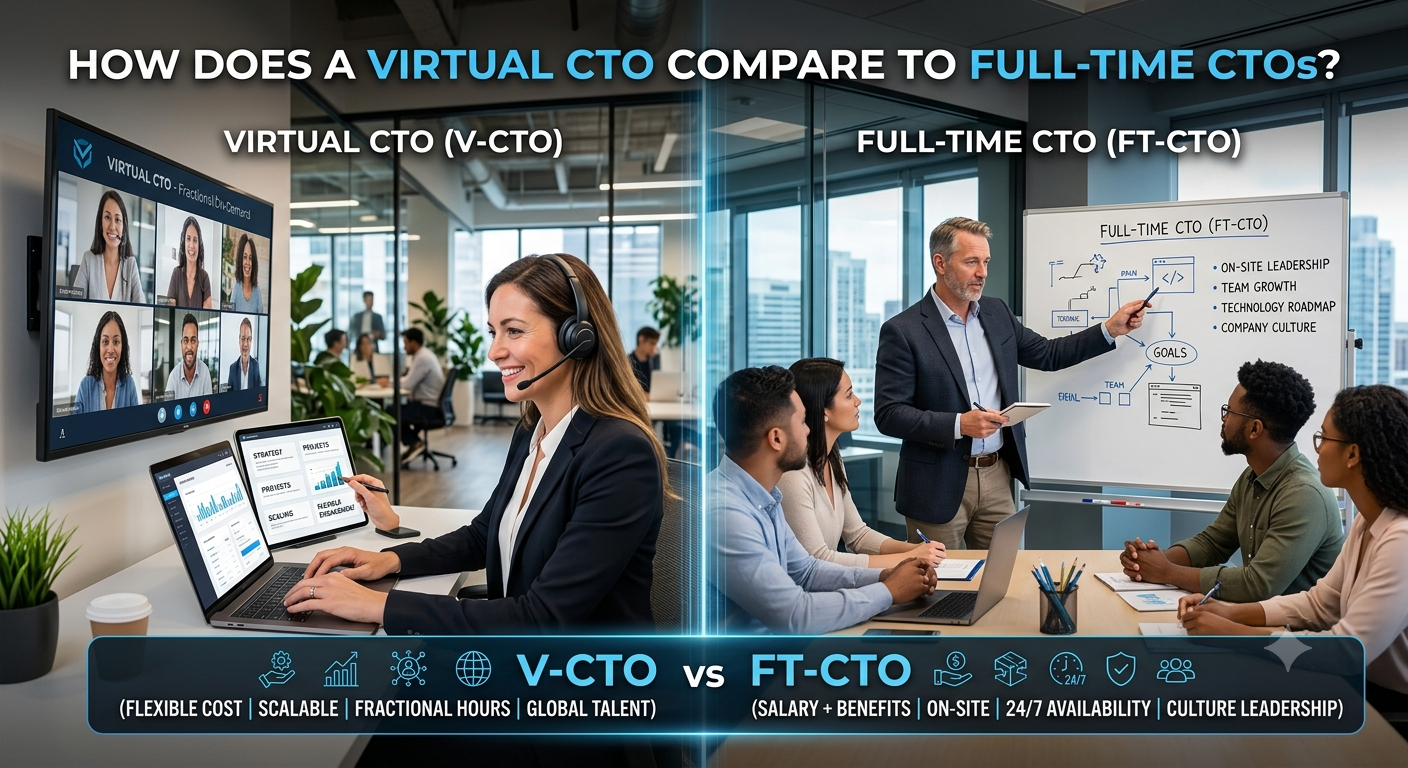
How Does a Virtual CTO Compare to Full-Time CTOs? Ultimate Guide

How Do You Implement AI Dynamic Pricing Today? Ultimate Guide

How Does a Virtual CTO Compare to Full-Time CTOs

How Does a Virtual CTO Compare to Full-Time CTOs? Ultimate Guide

Virtual CTO for FinTech Startups: Architecting Banking API Integrations With Zero Downtime

Fintech founders face a tough puzzle. You must launch fast, stay secure, and never let payments fail. Yet many startups cannot afford a full-time chief technology officer. Therefore, a virtual CTO for fintech startups can be a smart answer. This expert guides your technology plan on a flexible basis. One of the hardest tasks is connecting to banks through APIs without any downtime. This guide explains how a virtual CTO approaches that job. You will also learn the design habits that keep money moving.

What Is a Virtual CTO for FinTech Startups?

A virtual CTO is a senior technology leader who works with you part time or on contract. Some people call this role a fractional CTO. The person sets your tech strategy, guides your engineers, and reviews key choices. You pay only for the time you need. That makes the model a smart fit for early-stage teams.

Fintech adds special pressure to this role. Your product handles real money and sensitive data. Regulators watch closely, and customers lose trust fast after an outage. A virtual CTO who knows fintech understands these risks. They bring experience from many projects, so you avoid common traps.

Typical duties are broad. They pick the tech stack and design the system architecture. They set security standards and plan for compliance rules such as PCI DSS. Hiring and coaching developers is part of the job too. Most of all, they connect tech choices to business goals.

Compare this with a full-time CTO. A full-time hire costs more and may take months to find. A virtual CTO can start within weeks. As your company grows, you can move to a full-time leader with a clean plan already in place.

Consider a small payments startup with five engineers. The team knows how to build features but lacks bank experience. A virtual CTO reviews the plan, spots weak points, and sets clear standards. Developers gain confidence, and the founder gains a trusted adviser. Moreover, investors like to see this level of technical care.

Why Banking API Integrations Are Hard

Banking APIs let your app talk to banks and payment networks. They power account checks, payments, and balance data. Open banking rules in many regions make these APIs more common. However, each bank works differently. Formats, limits, and rules vary widely.

Banks also change systems without much warning. An API may slow down, return odd errors, or go offline for maintenance. Your product must handle all of this smoothly. A single weak link can freeze payments for thousands of users.

Security adds more weight. You must protect tokens, keys, and customer data at every step. Rules require strong authentication and careful logging. Mistakes can lead to fines and lost trust.

For these reasons, integration cannot be an afterthought. It needs a clear architecture from day one. That is exactly where a virtual CTO adds value.

Cost is another factor. Every hour of downtime can mean failed payments and angry customers. Support tickets rise, and partners start to worry. Additionally, repeated outages may put your bank relationship at risk. Prevention is always cheaper than recovery, and it keeps your team calm.

How a Virtual CTO Designs for Zero Downtime

Zero downtime means your service stays available even when parts fail or change. No system is perfect, but good design gets very close. Here are the core ideas a virtual CTO uses.

Build a Clean API Gateway Layer

A gateway sits between your app and every bank API. Your core product talks only to the gateway. The gateway handles each bank’s format, rules, and quirks. If a bank changes something, you fix one place instead of many. This also makes adding new banks much faster.

Use Retries, Timeouts, and Circuit Breakers

Networks fail often, so plan for that. Smart retries try again after a short pause. Timeouts stop your system from waiting forever. A circuit breaker cuts off a failing service for a moment so it cannot drag everything down. Together, these tools keep small problems small.

Make Payments Safe to Repeat

However, retries can cause double payments if you are careless. The fix is called idempotency. Each payment request carries a unique key. If the same request arrives twice, the system processes it only once. This protects customers and your reputation.

Add Backup Routes and Queues

Never depend on one bank connection for critical flows. A backup provider can take over when the main one fails. Message queues store requests safely during a slowdown. As a result, work continues once the service recovers. Customers see a short delay instead of an error.

Data consistency deserves attention too. When a payment moves between systems, every record must match. Reconciliation jobs compare your ledger with bank statements each day. Any gap triggers an alert. This habit catches quiet errors before customers notice them.

Release Without Stopping the Service

Deployments often cause outages. Blue-green deployment avoids this. You run the new version next to the old one and switch traffic only after tests pass. If something breaks, you switch back in seconds. Feature flags let you turn new code on for a few users first.

Testing, Monitoring, and Compliance

However, design alone is not enough. Teams must test and watch the system all the time. A virtual CTO builds these habits into your culture.

Start with sandbox testing. For example, most banks offer test environments. Run real scenarios there, including failures and slow responses. Load tests show how your system behaves at peak traffic. Chaos tests, which break parts on purpose, reveal hidden weak spots.

Monitoring comes next. Track response times, error rates, and payment success rates. Set alerts that reach the right person quickly, day or night. Dashboards should show the health of every bank connection at a glance. Clear logs help your team find causes in minutes, not hours.

Meanwhile, compliance needs equal care. Encrypt data in transit and at rest. Limit access with roles and strong authentication. Keep audit trails for every payment action. Plan regular security reviews and penetration tests. These steps satisfy regulators and calm nervous partners.

Finally, prepare for incidents. Write a simple runbook that explains who does what during an outage. Practice it with your team. After each incident, hold a blameless review and fix the root cause. Over time, your platform becomes tougher and easier to trust.

How to Work With a Virtual CTO for FinTech Startups

Set clear goals before you start. Do you need an architecture plan, a team review, or a compliance roadmap? Agree on deliverables and a schedule. Decide how you will measure success after three months. Ask for regular reports in plain language.

Look for real fintech experience. Ask about past banking API projects and how they handled outages. Check references and past results. Ask to see sample architecture notes or reports. A good virtual CTO explains complex ideas simply and listens to your business needs.

Treat the relationship as a partnership. Give access to your team, your data, and your roadmap. Involve your developers in decisions so knowledge stays in-house. Review progress each month. The best outcome is a stronger internal team that can run without constant outside help.

Conclusion: Keep Payments Running With the Right Tech Leadership

A virtual CTO for fintech startups gives you expert leadership without the cost of a full-time hire. Clean gateways, safe retries, backup routes, and careful releases help banking API integrations run with zero downtime. Strong testing, monitoring, and compliance make the system even more reliable. If your startup is growing fast, now is a great time to get expert guidance. Solid technology today protects your customers and your future. Take the first step by reviewing where your current integrations might fail.

How Does a Virtual CTO Compare to Full-Time CTOs

Frequently Asked Questions

What does a virtual CTO for fintech startups do?

A virtual CTO sets technology strategy, designs architecture, and guides engineers on a part-time basis. In fintech, they also focus on security, compliance, and banking API integration.

How is a virtual CTO different from a full-time CTO?

A virtual CTO works flexibly and costs less. A full-time CTO is embedded daily in your company. Many startups begin with virtual leadership and hire full-time later.

How can banking API integrations have zero downtime?

Use a gateway layer, retries, circuit breakers, backup providers, and blue-green releases. Add strong monitoring so problems are caught early.

When should a fintech startup hire a virtual CTO?

Hire one when you plan your first product build, prepare for a bank partnership, or face scaling problems. Early guidance prevents costly rework.

What is idempotency in payment APIs?

Idempotency means the same request gives the same result, even if sent twice. It stops duplicate charges when a retry happens.

Also Read:

How Do You Implement AI Dynamic Pricing Today? Ultimate Guide

How Do Modern Brands Manage B2B Payments? Ultimate Guide

How vCTO services help you avoid shiny-object syndrome in tech adoption

How Do vCTOs Drive Tech Strategy? A Complete Guide

How vCTO Services Help You Avoid Shiny-Object Syndrome in Tech Adoption

New technology launches almost every week. It is tempting to chase every trending tool. However, this habit often leads to wasted time, scattered focus, and money spent on the wrong priorities.

This pattern is known as shiny-object syndrome. Teams jump from tool to tool without a clear strategy. As a result, technology decisions become reactive instead of thoughtful, and budgets quietly drift away from what the business actually needs.

vCTO services offer a practical solution to this problem. A virtual chief technology officer brings structure and experience. In this blog, we will explore how vCTO services help businesses adopt technology wisely, from evaluating new tools to building a sustainable long-term road map.

What Is Shiny-Object Syndrome in Tech Adoption?

Shiny-object syndrome happens when teams chase new tools constantly. They adopt trending software without checking if it solves a real problem. This often leads to fragmented systems and wasted budgets.

Many startups fall into this trap early. Excitement around new AI tools or platforms can override careful planning. Consequently, teams end up with too many overlapping tools that quietly compete for the same job.

This problem also affects larger companies. Departments adopt tools independently, without company-wide coordination. Over time, this creates messy tech stacks that are hard to manage.

The root cause is usually a lack of clear technology strategy. Without a plan, every new trend looks appealing. This is exactly where vCTO services can make a difference.

Why Shiny-Object Syndrome Feels So Tempting

New tools often promise instant results with minimal effort. Marketing around trendy software tends to highlight quick wins. Naturally, busy teams find these promises hard to resist.

Social proof adds pressure, too. When competitors mention a new tool publicly, teams worry about falling behind. This fear-driven decision-making rarely leads to sound technology choices.

Understanding these psychological triggers helps teams pause before acting. Recognizing the pattern is the first step toward avoiding it. This is precisely where structured guidance becomes valuable.

What Do vCTO Services Actually Do?

A vCTO, or virtual chief technology officer, provides strategic tech leadership. Unlike a full-time hire, this role is flexible and often part-time. Businesses get expert guidance without the cost of a permanent executive.

vCTO services typically include technology road mapping and vendor evaluation. They also cover architecture decisions and team guidance. This support helps businesses avoid random, uncoordinated tech choices.

Additionally, a vCTO evaluates tools against real business goals. Instead of asking “is this trendy,” they ask “does this solve our problem.” This shift in thinking prevents impulsive technology purchases.

Many startups use vCTO services during early growth stages. At this point, technical decisions have long-term consequences. A wrong choice can be expensive to reverse later, especially once a whole team has built workflows around it.

Established businesses also benefit from vCTO services during digital transformation. Modernizing legacy systems requires careful planning. A vCTO ensures new technology fits existing infrastructure smoothly.

The Difference Between A vCTO And A Consultant

A general consultant often provides one-time advice on a specific project. A vCTO, however, stays involved over time as an ongoing strategic partner. This continuity allows for more consistent, informed decision-making.

Consultants may not fully understand a company’s internal culture or constraints. A vCTO builds that understanding gradually through regular involvement. As a result, their recommendations tend to fit the business more naturally.

This ongoing relationship also means faster response times. When a new tool trend emerges, a vCTO can quickly assess it. Businesses avoid delays that come from starting evaluations from scratch each time.

How vCTO Services Prevent Shiny-Object Syndrome

First, vCTO services introduce a structured evaluation process. Every new tool gets reviewed against clear criteria. This prevents teams from adopting software based on hype alone.

Second, a vCTO focuses on long-term technology strategy. Instead of quick fixes, they build road maps aligned with business goals. This approach naturally filters out unnecessary trendy tools that promise short-term excitement but little lasting value.

Third, vCTO services bring outside experience to internal decisions. Many tech trends look impressive but fail in practice. An experienced vCTO has often seen these patterns before, having watched similar tools rise and fade across other client engagements.

Moreover, a vCTO helps teams measure return on investment. Before adopting new technology, they calculate expected value. This data-driven approach reduces emotional or impulsive tech decisions across every department, not just engineering.

vCTO services also improve internal communication around tech choices. Teams understand why certain tools are approved or rejected. As a result, shiny-object requests decrease significantly over time.

Finally, a vCTO builds a repeatable decision framework. Future technology choices become faster and more consistent. This framework protects the business long after initial adoption decisions are made.

A Simple Framework vCTOs Often Use

Most vCTOs start by asking what specific problem a tool solves. If the answer is vague, the tool likely does not deserve further evaluation. This single question filters out a large share of shiny-object requests early.

Next, they assess integration effort against existing systems. A tool that looks impressive alone may create friction elsewhere. Weighing this trade-off prevents costly compatibility issues down the road.

Finally, they estimate the total cost of ownership, not just the sticker price. Training time, maintenance, and support all factor into this calculation. This complete picture leads to far more responsible technology adoption decisions.

Signs Your Business Needs vCTO Services

If your company constantly switches tools, this is a warning sign. Frequent tool changes usually signal a lack of clear strategy. vCTO services can help stabilize this pattern quickly.

Another sign is overlapping software subscriptions. If multiple teams use similar tools separately, costs add up fast. A vCTO can consolidate these choices efficiently.

Businesses without technical leadership often struggle here, too. Non-technical founders may feel unsure evaluating complex tech options. vCTO services fill this expertise gap affordably, without the overhead of a full executive hire.

Additionally, if technology decisions feel reactive rather than planned, it is time for guidance. A vCTO shifts your approach from reactive to strategic. This change saves money and reduces future headaches.

Frequent employee complaints about too many tools can also signal a problem. When staff struggle to remember which platform handles which task, productivity suffers. A vCTO helps simplify this complexity into a clear, well-organized tech stack.

Rapid growth stages also call for vCTO services. Scaling businesses need infrastructure that supports growth, not hype-driven choices. A vCTO ensures your tech stack grows sustainably.

Getting Started With vCTO Services

Begin by identifying your biggest technology pain points. This gives potential vCTO partners a clear starting focus. Vague goals tend to produce vague, less useful engagements.

Next, look for vCTO providers with experience in your industry. Familiarity with similar businesses speeds up the evaluation process significantly. It also reduces the learning curve during on-boarding.

Finally, set clear expectations around deliverables and check-in schedules. Regular reviews keep the engagement focused and accountable. This structure helps ensure vCTO services deliver measurable, lasting value.

How vCTO services help you avoid shiny-object syndrome in tech adoption

Conclusion

Shiny-object syndrome can quietly drain your budget and focus. Chasing every new tool rarely leads to lasting success. Instead, businesses need structured, strategic technology decisions.

vCTO services provide exactly this kind of guidance. They bring experience, structure, and clear evaluation frameworks to tech adoption. As a result, businesses avoid wasted spending and fragmented systems.

If your team keeps chasing trends without results, consider vCTO services. A virtual CTO can help you build a technology strategy that actually supports growth. This investment often pays for itself many times over.

Technology will keep evolving, and new trends will keep appearing. However, businesses with strong strategic guidance can evaluate these trends calmly. They adopt what genuinely helps and confidently skip what does not. That discipline, built through vCTO services, becomes a lasting competitive advantage that compounds year after year as the business continues to grow.

Frequently Asked Questions

1. What are vCTO services?

vCTO services provide part-time or flexible chief technology officer support, helping businesses make strategic technology decisions.

2. How do vCTO services prevent shiny-object syndrome?

They introduce structured evaluation processes, ensuring new tools align with real business goals instead of passing trends.

3. Who should consider hiring vCTO services?

Startups without technical leadership and growing businesses facing scattered tech decisions benefit most from vCTO services.

4. Are vCTO services cheaper than a full-time CTO?

Yes, vCTO services typically cost less since they offer flexible engagement without a permanent executive salary.

5. How do vCTO services improve technology ROI?

They evaluate tools based on measurable value, helping businesses avoid impulsive purchases and wasted technology spending.

Also Read:

Why Shoppers Abandon Mobile Carts, and How to Fix It

Payment Challenges: A Complete Guide for Indian Businesses

Â